
Summary for Decision-Makers
In 2026, emerging technology trends are no longer just signals of innovation. They are becoming practical tools for improving efficiency, reducing risk, strengthening customer experience, and building more scalable business operations.
For business leaders, the real question is not “Which technology is the newest?” It is “Which technology can solve a clear business problem now?”
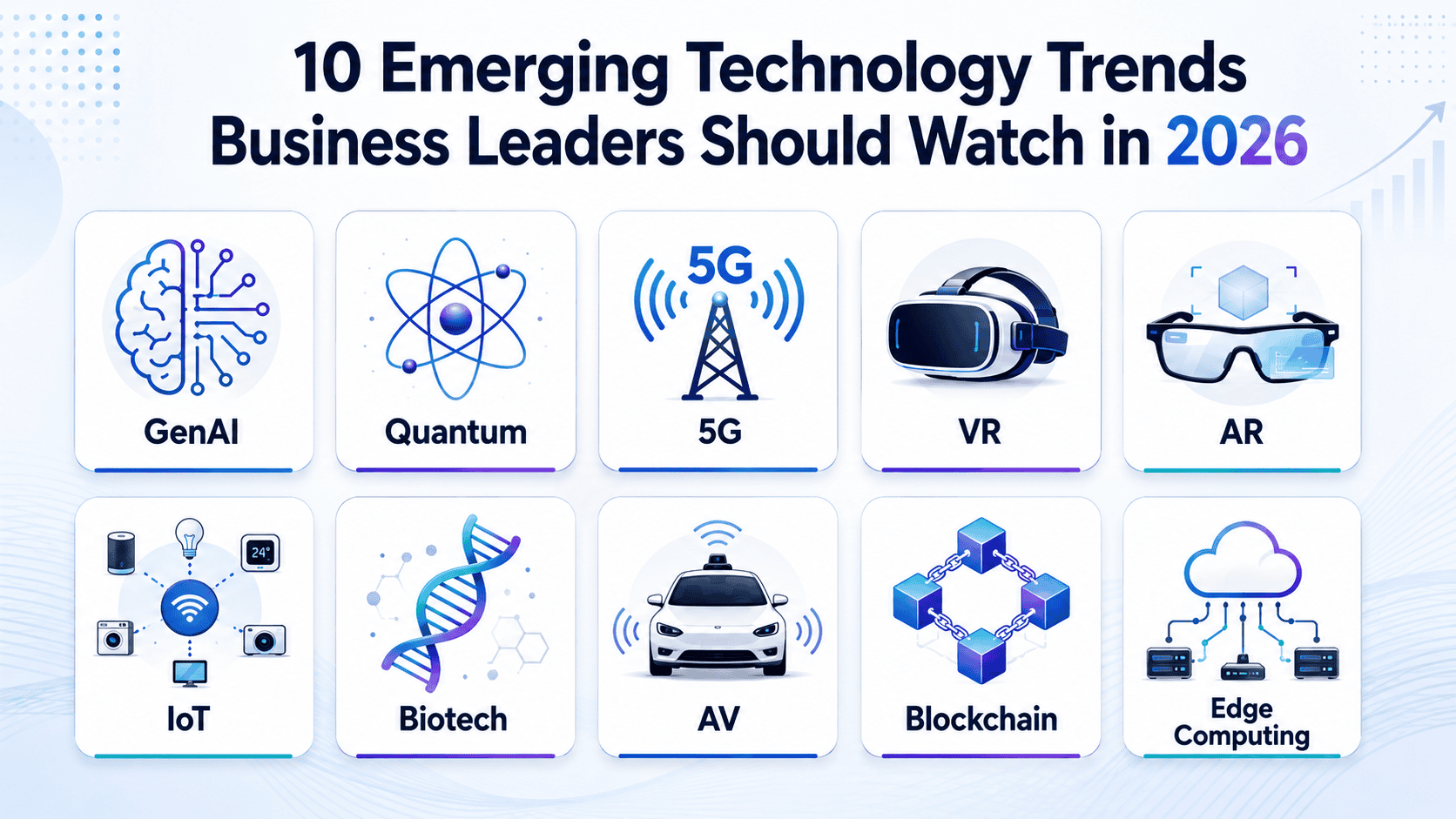
This guide breaks down 10 emerging technology trends shaping business in 2026, including generative AI, quantum computing, 5G, virtual reality, augmented reality, IoT, biotechnology in agriculture, autonomous vehicles, blockchain, and edge computing.
The key takeaway is simple: you do not need to adopt every trend. You need to identify which technologies align with your business goals, operational challenges, customer expectations, and long-term growth strategy.
Introduction: Why Emerging Technology Trends Matter for Business in 2026
Technology investment is becoming more selective in 2026. Many businesses have already tested AI tools, automation platforms, cloud systems, and digital workflows. The next challenge is turning those experiments into real business value.
For SMEs, startups, and growing enterprises, emerging technology is not only about innovation. It affects how teams operate, how products are built, how data is protected, how customers are served, and how quickly a business can respond to market changes.
This is especially important for businesses in fast-moving markets such as the UAE and the wider Middle East, where digital transformation, AI adoption, smart infrastructure, and secure cloud-based systems are becoming part of everyday business competition.
At Titani, we help business leaders connect emerging technology trends with practical solutions. In this guide, we break down the top 10 innovations shaping business in 2026.
In this guide, we cover 10 emerging technology trends business leaders should watch in 2026:
- Generative AI becomes agentic
- Quantum computing
- 5G and beyond
- Virtual reality
- Augmented reality
- Internet of Things
- Biotechnology in agriculture
- Autonomous vehicles
- Blockchain beyond crypto
- Edge computing
Let’s start with the trend leading most business conversations in 2026.
1. Generative AI Goes Enterprise
2023 was the year generative AI exploded. 2025 was the year it became mainstream. In 2026, the next shift is clear: businesses are moving from using GenAI tools to building AI-powered workflows, assistants, and agents into daily operations.
At its core, Generative AI refers to algorithms that can create original content, including text, images, audio, code, and business documents. But the bigger change is this:
Companies are not just using GenAI for content creation. They are integrating it into products, workflows, customer journeys, software development, and decision support.
Why it matters to SMEs:
Faster time-to-market for content, campaigns, software prototypes, and internal tools
Reduced cost for repetitive work, ideation, documentation, and support tasks
More personalized customer experiences across sales, service, and digital channels
- Stronger operational efficiency when AI is connected to CRM, ERP, support, and reporting systems
According to a joint report by Microsoft and LinkedIn (2024 Work Trend Index),
“71% of business leaders say they would rather hire a less experienced candidate with GenAI skills than a more experienced one without them.”
Real Use Cases We’ve Seen:
Proposal Generator: SMEs use GenAI to auto-generate draft proposals and customize them by client, industry, or project type.
Internal AI Assistants: Knowledge bots trained on company SOPs reduce internal support workload.
AI QA Testing Support: Combined with traditional QA, GenAI helps generate test cases, simulate edge scenarios, and speed up defect analysis.
Customer Support Automation: AI assistants help summarize requests, suggest responses, route tickets, and improve response time.
What to Watch:
As GenAI matures, expect agentic AI to become part of business operations. These AI agents will not only generate content. They can help trigger actions, coordinate workflows, analyze data, and support decisions across business systems.
For SMEs and growing enterprises, the best starting point is not to automate everything at once. Start with one high-friction process, such as customer support, reporting, lead qualification, proposal creation, or internal operations. Then test whether AI can reduce manual work, improve response time, or support better decisions.
💡 Want to explore how GenAI could reduce operating costs or improve delivery for your company? Let’s talk: https://titanisolutions.com
2. Quantum Computing: Unlocking the Next Tier of Problem-Solving
Quantum computing has long been considered “bleeding edge” — too abstract, too experimental. But in 2026, its early business applications are moving closer to real-world relevance, particularly in sectors that demand high-performance computing: pharmaceuticals, finance, logistics, and cybersecurity.
Unlike classical computers, which process data in binary, quantum computers use qubits. This allows them to perform certain types of complex calculations in ways conventional systems cannot handle efficiently.
Why it matters to SMEs (yes, even now):
You don’t need to own a quantum computer to benefit.
Cloud providers like IBM, Google, and Amazon are offering Quantum-as-a-Service (QaaS) models.Complex optimization problems — from supply chain routing to portfolio risk analysis — are becoming more solvable.
Quantum security is a rising concern. Understanding post-quantum encryption is important if your business handles sensitive or regulated data.
According to IBM’s quantum roadmap, the company is working toward near-term quantum advantage by the end of 2026 and a large-scale, fault-tolerant quantum computer by 2029.
Example Applications:
Drug Discovery: Simulating molecular interactions for faster R&D.
Logistics Optimization: Minimizing cost/distance/time in dynamic networks.
Finance Modeling: Exploring quantum algorithms for risk analysis, fraud detection, and market forecasting.
Cybersecurity Planning: Preparing long-term systems for post-quantum encryption standards.
📎 Want to dive deeper? Read IBM’s primer on Quantum Computing for Business
What to Watch:
In the next 3–5 years, quantum computing will move from labs to APIs. As open-source quantum toolkits grow (like Qiskit or Cirq), even SME dev teams will start experimenting with quantum workflows — often embedded in cloud platforms.
💡 Thinking ahead: SMEs in regulated industries such as finance and healthcare should begin evaluating quantum-safe encryption standards, especially if they manage sensitive customer data, long-term records, or intellectual property.
3. 5G & Beyond: Real-Time, Everywhere
The global rollout of 5G networks has been gradual, but by 2026, 5G is no longer just a future promise. It is becoming a practical connectivity layer for businesses that rely on real-time data, mobile applications, IoT devices, remote operations, and richer customer experiences.
For SMEs, this opens the door to a wide range of low-latency, high-bandwidth applications that were difficult to deliver consistently with 4G.
What Makes 5G So Transformative?
Speed: 5G can support much faster data transfer than previous mobile generations, making video, AR, and data-heavy applications smoother.
Latency: Lower latency enables more responsive digital experiences, from remote operations to real-time customer engagement.
Device density: 5G is designed to support large numbers of connected devices, making it especially useful for IoT-heavy environments.
Why it matters to SMEs:
Real-time services: Enable instant transactions, remote operations, live customer engagement, and faster field communication.
IoT integration: From smart factories to remote monitoring systems, 5G makes large sensor networks more practical.
Edge computing: Combine 5G with edge computing to process data closer to the device level, reducing cloud dependency and improving response time.
Use Cases Emerging in 2026:
Smart Warehousing: 5G-powered robotics systems support real-time inventory tracking, restocking, and warehouse visibility.
Telehealth: Medical SMEs are offering real-time diagnostics, remote consultations, and connected health monitoring with lower latency.
Augmented Reality Sales Tools: Field teams can use AR product demos, interactive walkthroughs, and real-time product visualization with less lag.
- Field Service Operations: Technicians can access live data, remote expert support, and digital repair instructions while working on-site.
What to Watch:
5G is also laying the groundwork for 6G, which is expected to bring more AI-native networks, advanced sensing, and richer immersive communication. While 6G is likely a longer-term reality, SMEs investing in 5G-compatible infrastructure today will be better positioned for future upgrades.
💡 Pro Tip: If you’re building customer-facing apps, test them on 5G to unlock richer experiences, such as instant video, AR overlays, faster onboarding, and real-time support.
4. Virtual Reality 2.0: Immersive Experiences Go Corporate
Virtual Reality (VR) has come a long way from gaming headsets and novelty demos. In 2026, VR is becoming more practical, more business-focused, and more relevant for companies that need better ways to train teams, present products, and collaborate remotely.
It is now a serious tool for training, onboarding, product walkthroughs, safety simulations, and remote collaboration. For SMEs in manufacturing, education, healthcare, real estate, construction, and professional services, VR can create a stronger sense of presence and engagement than standard video calls or static presentations.
What’s new in VR 2.0:
Higher resolution optics and lower motion lag
- More lightweight and standalone headsets that no longer require complex setup
Multi-user, real-time interaction for teams and clients
Enterprise-ready software platforms with analytics, tracking, and integration options
Why it matters to SMEs:
Reduce training costs: Simulate machinery operation, safety drills, or onboarding processes without physical risks.
Enhance sales experience: Let customers walk through virtual buildings, prototypes, showrooms, or service environments.
Improve remote collaboration: Create virtual meeting rooms, training spaces, and product demo environments that feel more interactive than standard video calls.
Example Scenarios:
A construction SME uses VR to present design mockups to clients across the UAE and Europe.
A healthcare training center onboards new staff with hands-on practice in a fully simulated emergency room.
A manufacturing company trains workers on safety procedures before they enter a real production environment.
A professional services firm uses immersive walkthroughs to explain complex solutions to clients.
What to Watch:
As VR platforms become more enterprise-ready, expect more industry-specific tools and integrations to emerge, from CRMs and ERPs to learning management systems and product visualization platforms.
💡 Founders note: VR can create differentiation not only in service delivery, but also in brand experience. Think of onboarding portals, immersive service demos, virtual training centers, or investor presentations that make your solution easier to understand and remember.
5. Augmented Reality (AR): Bridging Physical and Digital in Real Time
While VR creates entirely virtual environments, Augmented Reality (AR) overlays digital content onto the real world. In 2026, AR is becoming more accessible, mobile-friendly, and commercially viable for SMEs.
From real-time product visualization to field service enhancements, AR is helping businesses deliver smarter, faster, and more interactive experiences, especially in retail, real estate, manufacturing, and B2B sales.
What’s driving AR adoption in 2026:
Mobile-first AR SDKs: Tools like Apple’s ARKit and Google’s ARCore make it easier to build AR experiences for mobile users.
Smarter devices: More smartphones, tablets, and smart glasses now support AR natively
5G connectivity: Faster connectivity helps reduce lag and enables smoother real-time rendering.
Why it matters to SMEs:
Reduce purchase hesitation: Let customers visualize products in their space, such as furniture, machinery, or construction outcomes.
Boost service efficiency: Field teams use AR to access step-by-step repair guides or remote expert support.
Create engaging sales pitches: Use 3D models or layered data in live product demos without relying on physical samples.
Example Applications:
A real estate SME lets buyers "walk through" a property remotely via mobile AR.
A machinery distributor offers an AR app to show equipment setup in the client’s factory layout.
A cosmetics brand enables customers to test products virtually via their phone.
📎 Explore Google ARCore and Apple’s ARKit for implementation tools.
What to Watch:
Expect more AR-powered smart glasses tailored for enterprise use. As devices and platforms continue to evolve, fieldwork, logistics, and frontline roles may see stronger productivity gains from AR-supported workflows.
💡 Tip for Founders: If your sales process relies on trusting what can’t be seen yet (e.g. software, architecture, infrastructure), AR can bridge that gap better than static PDFs or slide decks.
6. Internet of Things (IoT): Smarter Devices, Smarter Decisions
The Internet of Things (IoT) — where everyday objects are connected to the internet and each other — is no longer a futuristic concept. In 2026, it continues to be a foundational layer for smart business operations, predictive analytics, and real-time decision-making.
According to IoT Analytics, the number of connected IoT devices reached 18.5 billion in 2024 and is expected to grow 14% year-over-year to 21.1 billion by the end of 2025, driven by adoption across smart homes, industrial automation, logistics tracking, healthcare monitoring, and connected retail.
Why it matters to SMEs:
Better visibility: Monitor equipment usage, asset location, energy consumption, and customer behavior in real-time.
Predictive maintenance: Reduce downtime by spotting issues before they escalate.
Cost optimization: Automate tasks like inventory restocking, HVAC control, or lighting, saving both time and resources.
Example Use Cases:
A logistics firm in Dubai tracks shipments across borders in real time using GPS-enabled IoT tags.
A food manufacturer uses sensors to monitor storage temperatures and avoid spoilage.
A retail SME connects shelves and POS systems to sync stock levels, promotions, and customer footfall analytics.
What to Watch:
As IoT and AI converge, expect smarter systems that not only collect data but also interpret and act on it autonomously. This is what we now call AIoT, or Artificial Intelligence of Things.
Edge computing is also critical: instead of sending all data to the cloud, devices can process info locally for faster, offline-ready insights — ideal for remote sites or real-time systems.
💡 Founder insight: If your business involves physical assets (vehicles, facilities, inventory), IoT isn’t just a trend — it’s the starting point for operational intelligence.
7. Biotechnology in Agriculture: Growing Smarter, Not Just Bigger
Biotechnology is transforming agriculture far beyond genetically modified organisms (GMOs). In 2026, it is about precision, resilience, and sustainability, solving real-world problems like food insecurity, climate volatility, and inefficient farming.
Through advances in genetic engineering, CRISPR gene editing, and molecular biology, agricultural SMEs can now optimize crops for drought resistance, higher nutritional value, and faster growth — all while reducing dependency on chemical inputs.
Why it matters to SMEs (especially in emerging markets):
Climate adaptation: Engineer crops to survive extreme heat, salinity, or water scarcity critically in regions like the Middle East, Africa, and South Asia.
Increased yields: Produce more with fewer resources — land, water, and labor.
Export advantage: Biotech-enhanced produce often meets stricter import standards for nutrition, shelf life, and traceability.
Example Applications:
An agritech startup in Vietnam uses gene-edited rice varieties that thrive in flood-prone areas.
A Gulf-region SME leverages CRISPR to grow tomatoes with longer shelf life, improving export potential.
Vertical farming companies in urban centers integrate biotech seeds for faster crop cycles and minimal pesticide use.
📎 Want to understand biotech’s business model potential? Read McKinsey’s Agriculture & Biotech report
What to Watch:
Biotech is merging with AI and IoT in smart farming — enabling automated precision agriculture. Startups are building platforms that track soil data, adjust watering schedules, and apply nutrients precisely based on genetic crop data.
💡 Founder insight: Even if you’re not in farming, expect biotech to influence food costs, supply chains, and sustainability certifications — especially if you operate in food, retail, or logistics sectors.
8. Autonomous Vehicles: Driving the Future of Logistics and Mobility
While fully self-driving cars are still navigating legal, ethical, and safety hurdles, autonomous vehicles (AVs) are making serious inroads in logistics, public transport, and controlled environments in 2026.
Enabled by AI, LIDAR, machine learning, and real-time edge computing, AVs are helping businesses move goods and people more safely, predictably, and efficiently.
Why it matters to SMEs:
Lower last-mile delivery costs: Autonomous delivery bots and semi-autonomous vans can support routine routes, especially in urban areas, campuses, warehouses, or gated communities.
Increased fleet efficiency: AV-assisted trucks and smart fleet systems can reduce idle time, improve routing, and support longer operating hours with fewer driver-related delays.
Improved safety planning: With the right controls and monitoring, autonomous and semi-autonomous systems may help reduce risks caused by human error in controlled environments.
Example Applications:
A logistics SME in Abu Dhabi deploys semi-autonomous electric vans for warehouse-to-retail restocking.
A university shuttle system uses AVs for student transport across campus, cutting staffing and fuel costs.
A farm equipment company offers self-driving tractors for plowing and harvesting in large-scale operations.
A warehouse operator uses autonomous forklifts and yard trucks to move goods more efficiently inside controlled facilities.
📎 For more context, explore Waymo’s use cases and Tesla’s Autopilot data
What to Watch:
The real growth is not only in fully self-driving cars. It is also in Level 2 and Level 3 autonomy, where vehicles can assist with steering, acceleration, braking, or certain driving tasks while still requiring human oversight.
In the B2B space, automated forklifts, yard trucks, delivery bots, and semi-autonomous fleet systems are becoming more common, even in SMEs that do not consider themselves “tech companies.”
💡 Founder tip: Don’t wait for robotaxis. Look into semi-autonomous solutions in warehousing, distribution, agriculture, or field services that can deliver practical ROI today.
9. Blockchain Beyond Crypto: The Trust Layer for Modern Business
Blockchain isn’t just about Bitcoin anymore. In 2026, it’s evolving into a trust infrastructure for digital business, providing transparency, immutability, and decentralized control across industries like supply chain, healthcare, real estate, and government services.
For SMEs, blockchain offers an affordable way to compete on trust and traceability, without needing massive back-end infrastructure.
Why it matters to SMEs:
Tamper-proof records: From invoices to contracts, blockchain ensures documentation can’t be altered post-creation.
Smart contracts: Automate business processes (e.g., payments, deliveries, SLAs) that self-execute once conditions are met.
Supply chain transparency: Track every step of a product’s journey — from origin to destination — and prove it with blockchain logs.
📎 Explore IBM Blockchain or Ethereum’s use cases
Example Applications:
A coffee SME in Ethiopia uses blockchain to verify bean origin and sell at premium prices abroad.
A pharma distributor in Dubai ensures authenticity of medicine batches using smart QR + blockchain records.
A freight forwarder integrates blockchain to eliminate delays in bill-of-lading documentation.
What to Watch:
Governments and major corporations are increasingly requiring verifiable sourcing, ESG compliance, and traceability — blockchain can be your passport.
In finance, Decentralized Finance (DeFi) models may soon offer SMEs alternative access to credit, insurance, or liquidity — bypassing traditional banks.
💡 Founder tip: If you're dealing with cross-border trade, certifications, or high-value items, a lightweight blockchain layer can dramatically improve your credibility and operational resilience.
10. Edge Computing: Power at the Point of Action
As data volumes grow and real-time processing becomes critical, edge computing has emerged as a core enabler for modern applications, particularly in manufacturing, logistics, healthcare, and retail.
Rather than sending all data to a centralized cloud, edge computing processes information locally, at the “edge” of the network, near the data source. This helps reduce latency, improve reliability, and support offline functionality.
Why it matters to SMEs:
- Speed: Make faster decisions — critical for automation, robotics, field operations, and customer-facing applications.
- Cost efficiency: Minimize bandwidth costs by reducing unnecessary cloud data transfer.
- Resilience: Keep systems running even if cloud connectivity drops, especially for field sites, remote operations, vehicles, or smart facilities.
📎 Learn more from Intel’s Edge Computing Overview
Example Applications:
- A logistics SME uses edge servers in delivery vans to process route optimization in real time, without relying on constant internet connectivity.
- A retail chain processes in-store customer behavior data locally to trigger instant promotions or adjust shelf displays.
- A smart factory uses edge sensors to monitor machine health and prevent downtime through predictive maintenance.
What to Watch:
Edge computing becomes even more powerful when combined with AI and IoT, forming what is now called Edge AI. Imagine smart cameras that not only detect activity but also interpret it on the spot, such as suspicious behavior, inventory errors, safety risks, or equipment anomalies.
💡 Founder tip: If your operations rely on physical infrastructure, mobility, or real-time responsiveness, edge computing could reduce cloud costs while improving reliability. That makes it a practical win for SMEs looking to scale smarter.
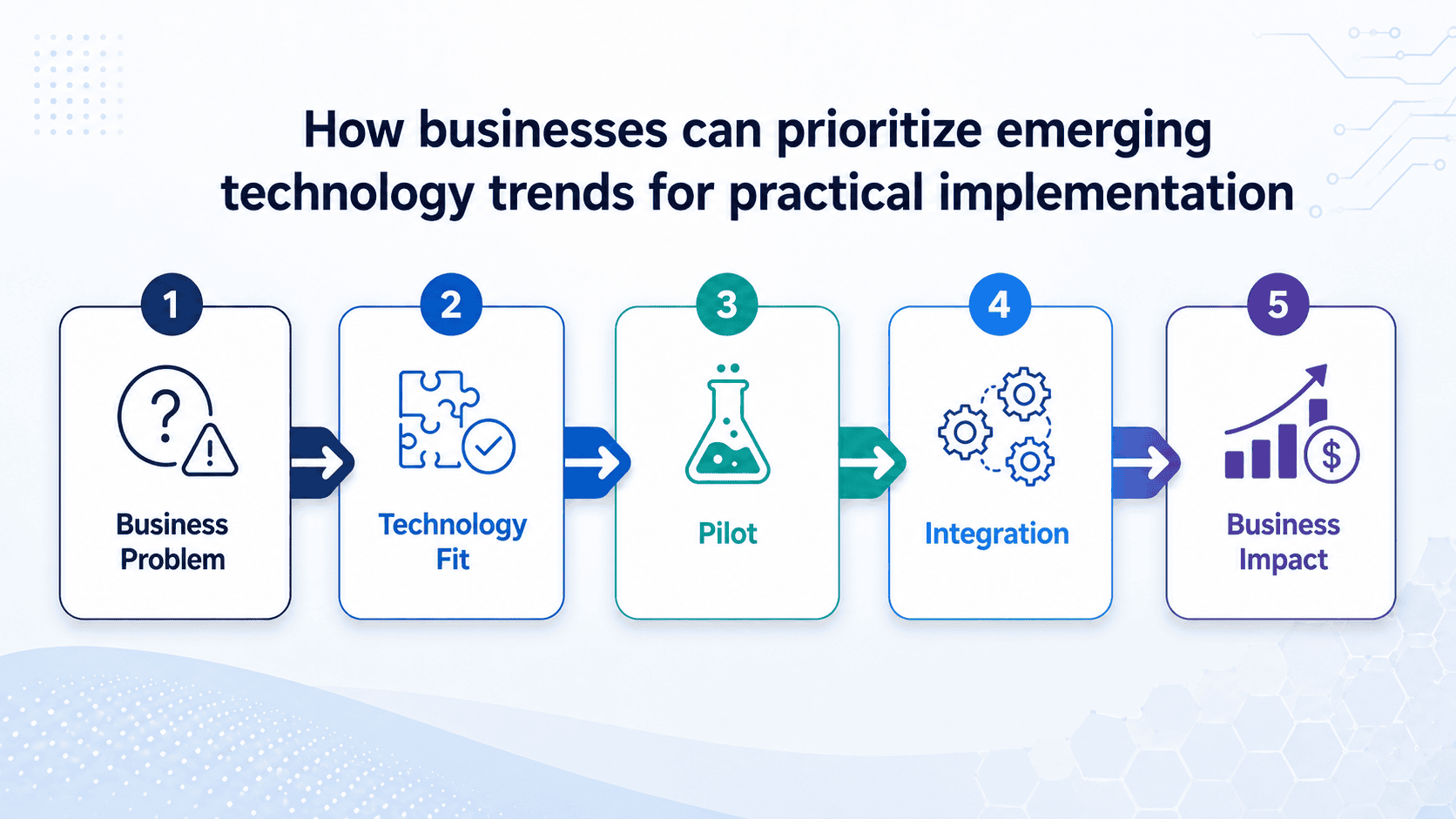
How to Prioritize Emerging Technology Trends for Your Business
Not every emerging technology trend needs immediate investment. For SMEs and growing enterprises, the smartest approach is to prioritize technologies based on business value, operational readiness, and implementation risk.
Before adopting any new technology, business leaders should ask:
Does this solve a clear business problem?
Start with pain points such as slow workflows, rising costs, poor visibility, manual reporting, customer friction, or security risks.
Can this technology integrate with our existing systems?
A new solution should work with your current CRM, ERP, website, mobile app, data platform, or internal workflow.
Do we have the right data and process foundation?
AI, IoT, automation, and analytics only work well when the underlying data and processes are reliable.
Can we test it with a small pilot first?
Instead of launching a large transformation project immediately, start with a focused use case, clear success metrics, and a practical roadmap.
Will it create measurable business impact?
Prioritize technologies that can improve efficiency, reduce cost, increase revenue, strengthen security, or improve customer experience.
The goal is not to chase every innovation. The goal is to turn the right technology into a practical business solution.
Conclusion: From Emerging Technology Trends to Real Business Solutions
Emerging technology trends in 2026 are not just about what is new. They are about what can create real value for businesses.
Generative AI, quantum computing, 5G, VR, AR, IoT, biotechnology, autonomous vehicles, blockchain, and edge computing are changing how companies operate, compete, and serve customers. Some of these technologies are ready for practical implementation today. Others are signals that business leaders should monitor for long-term planning.
For SMEs and growing enterprises, the best strategy is to start with business needs first. Identify the workflows, customer experiences, data challenges, or operational bottlenecks that need improvement. Then choose the technology that can solve the problem in the most practical, secure, and scalable way.
At Titani, we help businesses move from technology ideas to real implementation. Whether you are exploring AI-powered workflows, custom software, automation, data solutions, QA testing, or digital transformation, our team can help you assess the right use case and build a practical roadmap.
Ready to turn emerging technology into a business solution? Contact Titani to discuss your next digital initiative.