
Summary
AI is becoming a practical operational necessity, helping businesses overcome data fragmentation, manual inefficiencies, and rising complexity by improving accuracy, decision speed, and workflow stability.
Core AI solutions — from AI-powered ERP and modern data automation to GenAI, cybersecurity AI, and analytics platforms — create measurable impact through better forecasting, fewer errors, stronger governance, and real-time insight generation.
Agentic assistants, cloud AI services, IoT + AI, and predictive maintenance extend automation deeper into daily operations, enabling teams to shift from reactive management to proactive, insight-driven execution.
Successful adoption depends on foundations such as data quality, integration maturity, and governance, ensuring AI outputs remain consistent, auditable, and scalable across business workflows.
Businesses see the strongest ROI when they start small, validate outcomes, and scale intentionally, focusing on high-friction workflows where AI can reduce cost, strengthen accuracy, and support teams more effectively — a transformation Titani Global Solutions helps accelerate.
Many businesses eventually reach a point where familiar processes no longer keep up with growing complexity. Reports slow down, data remains scattered, teams react to issues instead of preventing them, and small errors begin to create real financial impact. Leaders recognize these signals early, but choosing the right path forward is rarely simple.
AI solutions are becoming that path for many organizations. They offer practical ways to improve accuracy, speed, and decision-making without forcing disruptive change. When implemented well, AI can turn fragmented information into meaningful insight and automate work that previously consumed valuable time.
The real challenge is identifying which AI solutions truly add value and which may complicate operations. This guide introduces 10 proven AI solutions and the key considerations leaders should evaluate to ensure long-term stability and measurable results.
1. Why Modern Businesses Need AI Solutions Now
Modern businesses are operating under sustained pressure. Global data volumes continue to surge, growing 28% annually according to Statista, yet many organizations still struggle to turn information into timely and accurate decisions. With 60% of CEOs expecting margin compression through 2026, the need for efficiency, accuracy and operational resilience has become urgent rather than optional.
These challenges rarely stem from a lack of technology. They arise because existing systems do not work cohesively. Data is trapped in silos, quality varies across departments and automation exists in isolated pockets that cannot scale safely. Even digitally mature businesses acknowledge that expanding automation without sacrificing visibility, governance or reliability remains a significant hurdle.
Leaders also face understandable concerns. Implementation costs can escalate quickly, teams may feel overwhelmed by unfamiliar tools and ensuring consistent governance across complex workflows is difficult. These challenges reflect the practical and often underestimated realities of deploying businesses grade AI.
This is where modern AI solutions begin to create meaningful impact. When selected strategically and deployed with intention, they strengthen core processes, reduce avoidable errors and turn fragmented operations into coherent, insight driven workflows.
At Titani Global Solutions, we see this shift across industries as organizations move from experimentation to outcome driven adoption. With the right data foundation and governance in place, AI becomes more than an enabler. It becomes a steady operational advantage that helps businesses navigate rising complexity with clarity, confidence and control.
2. AI-Powered ERP: Automating the Backbone of Business Operations
ERP platforms serve as the operational backbone for most organizations, connecting finance, supply chain, HR, procurement and other essential workflows. Yet many traditional systems struggle with rising workloads, rapid market changes and manual processes that slow decisions and create inconsistencies across departments.
AI powered ERP systems help close these gaps by improving accuracy, speed and reliability. Embedded models analyze historical and real time data to enhance forecasting, detect financial anomalies earlier and unify information that previously lived in silos. Leading platforms such as Microsoft Dynamics 365 and Oracle Cloud ERP already use AI to deliver more precise demand planning and earlier insight into supply chain risks.
The benefits are practical and easy to observe:
AI-enhanced forecasting reduces costly overstocking and unexpected shortages.
Automated reconciliation improves financial accuracy and minimizes manual error.
Intelligent supply chain automation helps teams identify and plan around disruptions with greater confidence — capabilities strengthened further by AI productivity tools embedded inside modern ERP systems.
In sectors like retail, these capabilities have contributed to stronger margin protection and more accurate inventory planning, as highlighted in our insights on AI in Retail.
Successful adoption requires readiness. Organizations must ensure clean, connected data and stable workflows so AI outputs remain reliable. Integration maturity is equally important to avoid duplicated effort and operational friction.
When implemented effectively, AI enhanced ERP becomes a strategic foundation for scaling automation and maintaining resilient operations through 2026 and beyond.
3. Modern Data Automation: Moving Beyond RPA
Modern businesses now generate data at a scale that manual processes and traditional RPA cannot sustain. This shift has pushed organizations toward machine learning driven automation that can interpret data, recognize patterns and adjust workflows in real time. Unlike earlier systems that only executed predefined steps, modern automation engines learn from context and support far more complex, businesses level operations.
These capabilities become especially valuable when applied to daily operational processes:
Intelligent data pipelines automatically clean, validate and merge information across ERP, CRM and warehouse systems, eliminating hours of manual reconciliation.
Automated reporting engines help finance teams consolidate multi source data and produce real time dashboards within minutes.
Anomaly detection models flag unusual order behavior or potential supplier delays early, giving managers time to intervene before disruptions escalate.
The impact is measurable. McKinsey reports that intelligent automation can reduce manual data processing time by 20–30% and lower error rates by up to 40%. These gains accumulate over time as workflows become more consistent and less dependent on manual oversight.
Leading platforms such as SAP, Epicor and Infor have already embedded these capabilities, allowing businesses to scale repetitive processes without adding headcount or increasing operational risk.
To unlock this value, organizations must ensure two critical foundations. First, strong data hygiene so machine learning workflows operate on clean and reliable information. Second, robust system integration so data can move smoothly across platforms without friction.
With these prerequisites in place, advanced data automation becomes more than an operational upgrade. It provides a dependable core that supports faster processes, more accurate insights and a more resilient decision-making environment across the businesses.
4. Generative AI for Content, Knowledge, and Customer Experience
Generative AI is becoming an essential support layer for modern businesses, not only because it generates content or summarizes documents, but because it creates consistent and governed access to organizational knowledge. As information continues to expand across teams and systems, GenAI helps employees retrieve the right insight at the right moment, without navigating scattered documents or outdated sources.
Its value is most visible in practical use cases:
Marketing and communication teams can generate first draft reports, summaries and campaign concepts within minutes.
Internal teams can use conversational search to retrieve policies, manuals and project information without time consuming lookup.
Customer facing functions benefit from AI assisted responses that provide quicker and more relevant interactions.
For businesses, the real advantage appears only when GenAI operates under strong governance. Without validation rules, access controls and defined quality checkpoints, AI generated text can introduce outdated references, compliance risks or inconsistent interpretations that quietly accumulate over time. These hidden costs often exceed the time savings GenAI initially provides.
A practical example illustrates this. A retail finance team cut its weekly reporting process from 18 hours to 40 minutes after adopting GenAI summarization. The gains were sustainable only after governance ensured the system referenced approved financial data, preventing inaccuracies that had previously slipped into draft reports.
Applied thoughtfully, generative AI does not replace human expertise. It enhances it safely, helping teams communicate more effectively, access knowledge faster and deliver more reliable outcomes across the businesses.
5. Real-Time AI Cybersecurity for Modern Businesses
As businesses become more connected, security teams face threats that move too quickly for manual detection. AI-powered cybersecurity tools help close this gap by analyzing large volumes of activity data and identifying unusual patterns the moment they appear.
In practice, these systems monitor network traffic, login behavior, and data movement to catch signs of risk early. For example, AI can spot an employee account accessing systems at abnormal hours, detect unusual file transfers that may indicate data exfiltration, or recognize login attempts that resemble credential-stuffing attacks.
Key applications include:
Real-time threat detection: identifying suspicious activity before it becomes a breach.
Fraud prevention: flagging irregular financial transactions or unauthorized access attempts.
Faster investigation: grouping related alerts so security teams focus on the issues that matter.
Organizations using AI in their security operations report faster response times and fewer false positives, giving small teams the capacity to protect increasingly complex environments.
AI does not replace cybersecurity professionals, but it strengthens their ability to see threats early and respond with confidence.
6. AI Analytics Platforms That Improve Decision Quality
Many organizations collect massive amounts of data, yet still struggle to turn it into clear, actionable insights. AI-driven analytics platforms help bridge this gap by identifying patterns, trends, and anomalies that traditional reporting tools often miss.
In practice, these platforms can predict sales trends, highlight unexpected cost spikes, or surface operational bottlenecks from complex datasets. For example, a logistics company can use AI analytics to forecast delivery delays based on weather and traffic patterns, while a finance team may use it to detect unusual spending behavior across departments.
Common applications include:
Trend forecasting: predicting demand, revenue fluctuations, or seasonal patterns.
Anomaly detection: spotting irregular transactions, cost deviations, or operational outliers.
Automated insights: summarizing performance metrics so leaders can understand issues quickly — capabilities increasingly strengthened by modern business AI solutions.
For many businesses, the biggest advantage is speed. Instead of waiting days for manual reports, teams can access real-time insights that support fast, confident decision-making.
When used well, AI analytics becomes a decision-support layer across the organization, helping leaders anticipate risks, optimize operations, and allocate resources more effectively.
7. Agentic & Conversational AI Assistants for Business Workflows
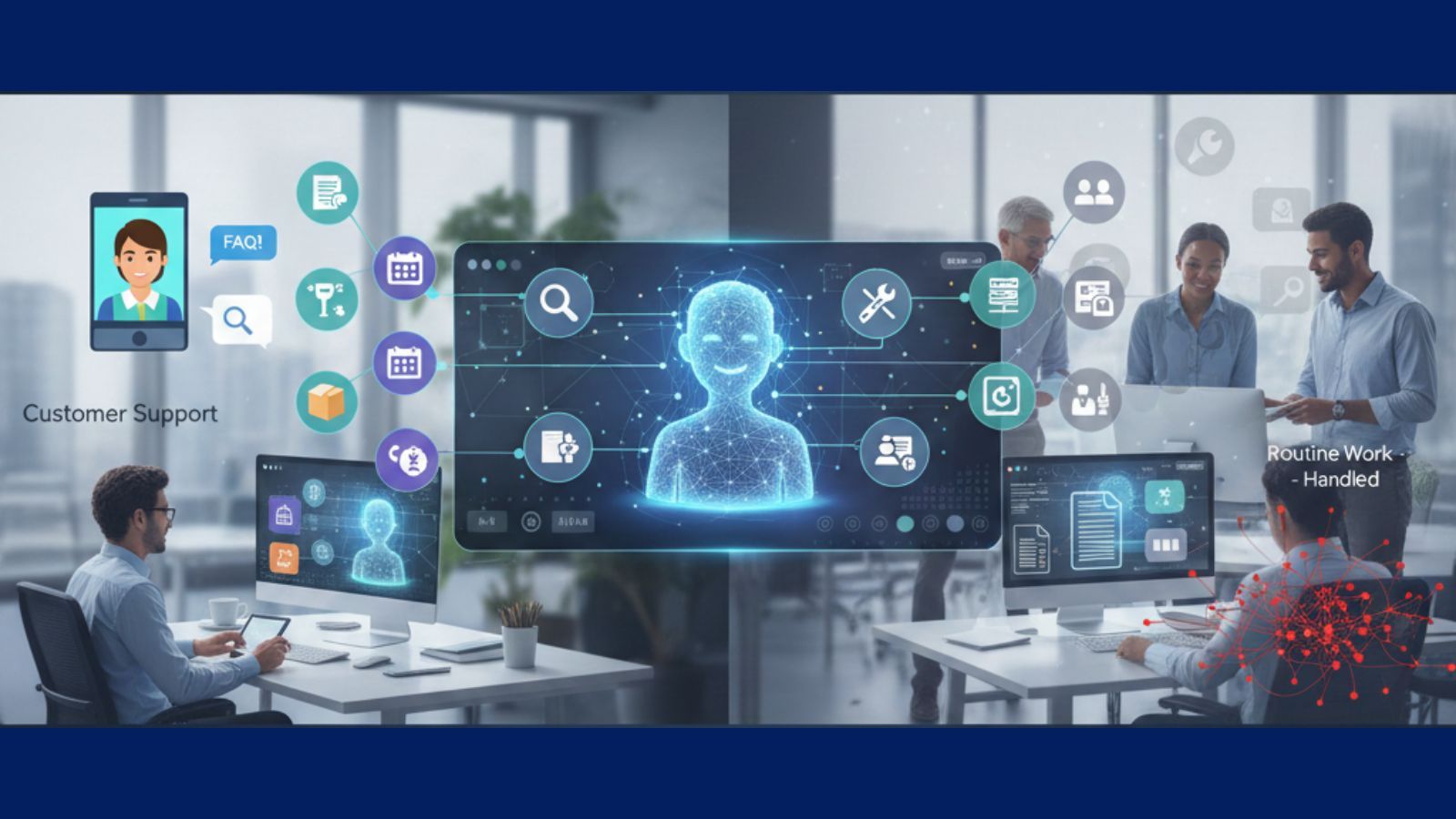
Conversational AI has evolved significantly beyond traditional chatbots. Modern agentic AI assistants now execute multi-step workflows, make context-aware decisions, and trigger downstream actions — turning them into operational partners rather than response tools.
In practice, these assistants streamline everyday tasks:
Customer support: answering common inquiries, guiding troubleshooting, or providing order updates.
Internal help: retrieving policies, documents, or project details through natural-language search.
Operational workflows: assisting HR, IT, or operations teams by automating routine requests — some of the most widely adopted AI automation examples in modern businesses.
A real-world example illustrates this shift: A logistics company deployed an internal agentic assistant that now processes 72% of HR requests autonomously — from policy questions to data updates and approval routing. What previously required three manual touchpoints is now completed in seconds.
The risk arises when organizations implement assistants without workflow visibility or governance. Poorly supervised AI can produce inconsistent responses, misroute requests, or bypass audit requirements — creating new operational noise.
Used thoughtfully, agentic AI becomes a scalable operational layer, allowing teams to focus on complex, human-critical interactions while routine work is handled reliably in the background
8. Cloud-Based AI Services for Scalable Business Deployment
Cloud-based AI services allow organizations to deploy models quickly without needing extensive on-premise infrastructure. This makes AI adoption more accessible, especially for teams that want to experiment, prototype, or scale solutions without large upfront investment.
In real-world operations, cloud AI is used to:
Deploy AI models at scale, such as recommendation engines or demand-forecasting models.
Run analytical workloads, including data processing or insight generation that would overwhelm local systems.
Support AI-enabled applications, from chatbots to document-processing tools, with reliable uptime and flexible capacity.
Platforms like AWS, Google Cloud, and Microsoft Azure offer managed services that handle compute, storage, and security, allowing teams to focus on building value instead of managing infrastructure.
The primary benefit is flexibility. Organizations can scale resources up or down as needs change, ensuring predictable costs and stable performance — especially when deploying cloud-native business AI tools across multiple environments.
When used strategically, cloud-based AI becomes a foundation for experimentation and innovation, helping businesses move from isolated pilots to production-ready systems with far greater ease.
9. Predictive Maintenance and Operations Intelligence
Predictive maintenance uses AI to analyze equipment data, identify patterns and detect early signs of failure before disruptions occur. Instead of relying on scheduled checks or reacting after breakdowns, organizations can anticipate issues and plan maintenance more efficiently.
In practical terms, AI driven maintenance helps teams monitor equipment health in real time, predict component failures based on vibration, temperature or performance abnormalities and optimize maintenance schedules to reduce downtime and unnecessary servicing.
Real world examples are already common. A manufacturing plant may detect unusual vibration patterns days before a breakdown, while logistics companies use similar models to forecast vehicle maintenance needs, preventing delays and reducing repair costs.
These improvements lead to fewer unexpected outages, lower operational expenses and longer equipment lifespan, and when predictive maintenance is embedded into daily operations it shifts organizations from reactive to proactive management, resulting in more stable and reliable production environments.
10. IoT + AI Integration for Real-Time Operational Optimization
The combination of IoT and AI gives businesses real-time visibility and the ability to act on insights the moment they appear. IoT devices collect continuous data from machines, vehicles, and physical environments, while AI models interpret that data to detect patterns, predict issues, and automate responses.
In real-world settings, this integration enables:
Smart manufacturing: machines adjust performance automatically based on sensor data to maintain quality and reduce waste.
Logistics tracking: AI analyzes IoT signals from trucks or containers to predict delays and optimize delivery routes.
Energy management: buildings adjust cooling, lighting, or equipment usage based on occupancy and energy-demand predictions.
These capabilities help organizations reduce manual monitoring, improve operational efficiency, and respond faster to changing conditions.
When combined with strong data connectivity, IoT and AI create a self-improving environment where systems learn continuously and support more autonomous operations across the business.
11. How to Choose the Right AI Solutions for Your Business
Selecting the right AI solutions is not just a feature comparison. It is a decision about risk, stability, and long-term operational sustainability. Many businesses underestimate the hidden costs of choosing the wrong solution — including workflow fragmentation, inconsistent outputs, rising infrastructure spend, or automations that cannot be audited.
A real scenario demonstrates this risk: A mid-sized manufacturer adopted an AI scheduling tool that optimized production sequences but ignored maintenance cycles due to incomplete data. Within weeks, unplanned downtime increased by 12% before the project was halted.
To avoid these pitfalls, leaders should evaluate AI solutions through a more strategic lens:
Identify high-friction workflows: Repetitive, error-prone tasks deliver the fastest ROI when automated with AI.
Assess data readiness: AI accuracy depends entirely on data quality, lineage, and accessibility.
Evaluate integration fit: AI must complement ERP, CRM, and workflow tools — not operate as a silo that creates parallel processes.
Understand the cost trajectory: Model how compute, storage, and model updates will affect cost over 12–24 months.
Start small with governance in place: Pilot with clear metrics, validate results, and scale only when workflows are stable and auditable.
This approach helps organizations adopt AI with clarity and control — ensuring automation strengthens operations rather than complicating them.
12. Conclusion: Automate Smarter, Not Faster
Adopting AI solutions is not a race. It is a long-term capability that becomes more valuable as organizations define clear goals, strengthen data foundations, and scale automation in a measured, responsible way. The most successful AI initiatives start small, demonstrate real outcomes, and expand only when teams are ready.
For leaders navigating increasing operational complexity, the next step is not to adopt every AI tool, but to identify where automation can genuinely reduce friction, improve accuracy, and support teams more effectively. Thoughtful implementation will always outperform rapid, unfocused adoption.
If your organization is evaluating where AI can deliver meaningful impact, Titani Global Solutions can help with guidance, implementation expertise, and practical support grounded in real business environments. You can reach our team directly through our Contact Page to discuss the approach that fits your goals.