
Summary
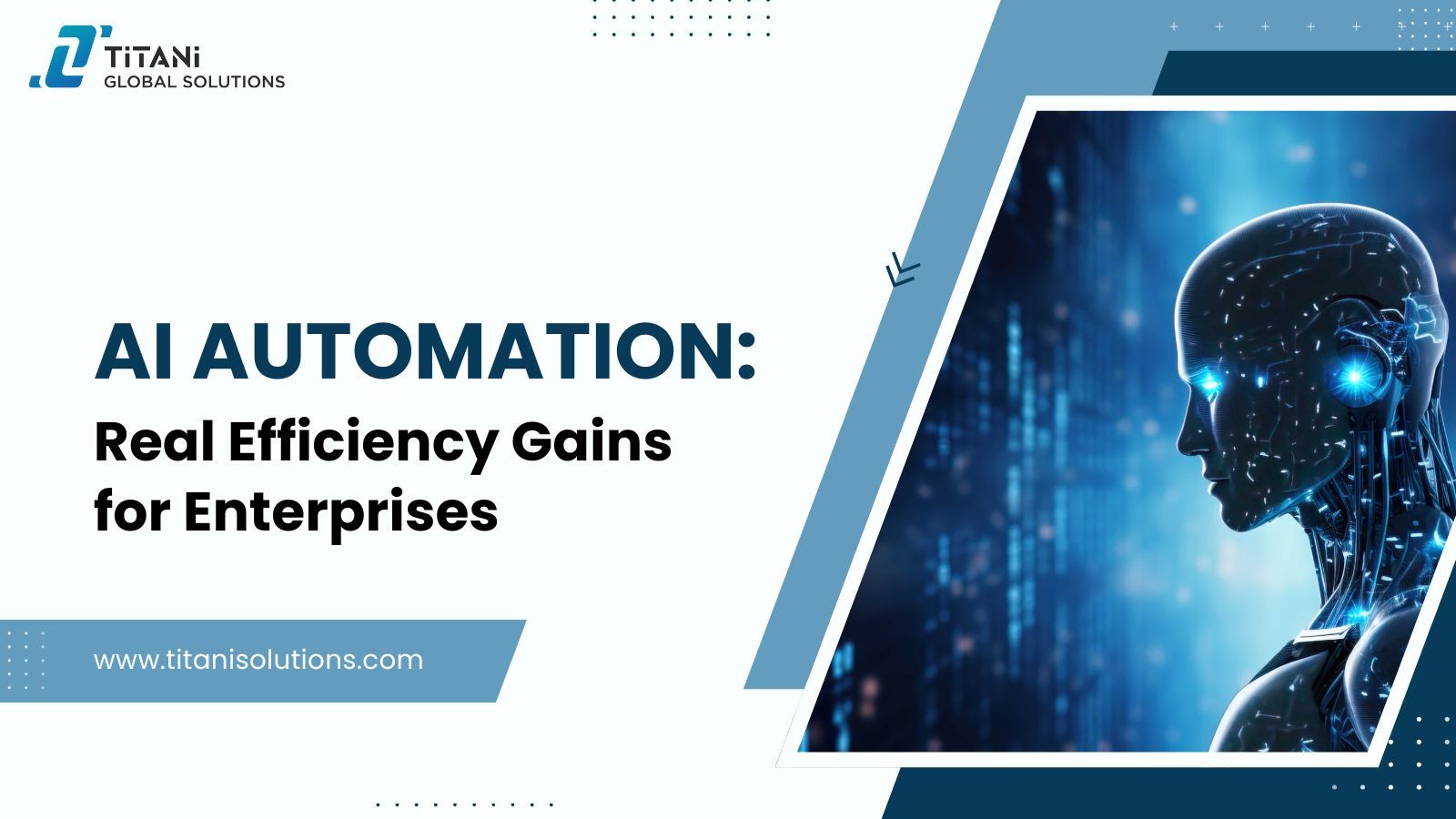
AI automation removes operational friction, not by replacing people, but by connecting systems, interpreting context, and coordinating actions across end to end workflows.
The real efficiency gains come from five levers: workflow orchestration, decision speed, data quality, cross-system automation, and intelligent routing.
Success depends on strong foundations, including clean and integrated data, team readiness, and responsible governance with clear human oversight.
Choosing the right automation approach requires five pillars: deep integration, built-in governance, scalability, explainability, and usability for non technical teams.
AI is evolving into a strategic partner, powered by AI agents, unified operational layers, and predictive decision support, giving early adopters a long term competitive advantage.
Most enterprises are not slowed down by a lack of talent or technology. They are slowed down by the gaps between their systems, by constant handoffs, and by thousands of small decisions waiting for someone to act. Over time, this silent friction pulls even strong teams off their momentum.
AI automation removes that friction. It understands context, connects workflows, and takes action in real time, allowing operations to move with the speed and clarity that modern business demands.
The real question for leaders is simple: Where does AI truly create measurable efficiency, and how do you avoid turning it into just another tool in an already crowded stack?
This article explores how AI automation works inside the enterprise and the specific levers that unlock meaningful and scalable operational impact.
What AI Automation Really Means for Modern Enterprises
AI automation is not about adding another tool to an already crowded tech stack. It represents a shift from manual and repetitive decision-making toward systems that understand context, act intelligently, and support teams throughout entire workflows.
What sets AI automation apart is its ability to adapt as conditions change. It can interpret new inputs, respond to unexpected variations, and remain reliable even when processes evolve.
Traditional automation works differently. It follows fixed rules and breaks easily when one step in the process changes. AI automation interprets data, recognizes patterns, understands natural language, and adjusts its actions in real time. This flexibility gives enterprises a level of resilience that rule-based systems cannot deliver.
To understand this evolution clearly, automation can be viewed across three layers:
Standard Automation: Handles predictable, repetitive tasks.
AI Automation: Interprets context to guide decisions in real time.
AI Agents: Manage entire multi-step workflows while keeping humans informed and in control.
These layers determine how much operational friction an organization can remove. Basic automation helps teams move faster. AI automation helps them move smarter, reducing delays, improving consistency, and enabling workflows that scale with the business.
At Titani Global Solutions, this perspective guides how we design automation systems. We focus on building intelligent and adaptable workflows that match the pace and complexity of modern enterprise operations.
How AI Automation Works Behind the Scenes
AI automation can seem like a “black box,” but in practice it follows a clear and predictable sequence. Once you understand how these layers work together, the benefits become concrete—not theoretical—and the efficiency gains much easier to measure.
1. Unifying Your Operational Data
Every enterprise sits on a goldmine of data scattered across CRMs, ERPs, HR systems, ticketing tools, and IT environments. The challenge is that these systems rarely integrate smoothly. According to McKinsey, companies activate less than 30% of their available data for day-to-day decision-making.
AI automation begins by breaking these silos. It unifies fragmented data into a single operational layer, giving the system a real-world view of how work actually moves across your business—not just how it’s documented on paper. This connected foundation becomes the fuel for every intelligent workflow.
2. The Intelligence Layer: Understanding Context
Once data is connected, the intelligence layer interprets what the information means. It combines:
Machine Learning (ML): identifies patterns and predicts outcomes
Natural Language Processing (NLP): understands requests from emails, messages, and tickets
Large Language Models (LLMs): apply reasoning, assess context, and make adaptive decisions
This adaptability is what makes AI automation more resilient than rule-based workflows. When a condition changes or a new scenario appears, the system continues to operate instead of breaking.
Practical example : A customer writes, “I need to update my shipping address and check the status of my previous order.”
AI understands this as a multi-step request, extracts the right details, updates the order, and creates a follow-up task for the support team.
3. The Orchestration Engine: Taking Action
After the AI “thinks,” the orchestration engine “acts.” It executes decisions across your entire tech stack:
Updating records automatically
Routing requests to the correct team
Escalating anomalies in real time
Coordinating multi-step workflows end to end
According to Deloitte, organizations that use AI for workflow optimization can reduce process cycle times by 30–50%, largely by removing manual handoffs and bottlenecks from critical processes.
Human oversight still remains essential. Teams review exceptions, validate sensitive decisions, and ensure governance, while AI handles the repetitive work that slows down operations.
Practical example : In recruiting, AI can screen resumes, schedule interviews, fill in missing candidate information, and create onboarding tasks automatically. HR teams focus on evaluating people instead of managing administrative tasks.
What Actually Improves Operational Efficiency?
Many organizations expect AI to deliver dramatic improvements, yet only a few achieve meaningful results. The reason is not the technology but the focus. Real efficiency comes from removing the deeper sources of operational friction, not from accelerating isolated tasks.
Below are the five levers where AI automation consistently creates measurable and compounding impact.
1. End to End Workflow Transformation
Most automation efforts target single tasks such as generating a report or creating a ticket. The real delays occur in the handoffs that surround those tasks, including validations, follow ups, and coordination across teams.
Reducing a ten minute task to one minute is useful. Eliminating the forty minutes of manual work that surrounds the task is transformative. End to end automation can reduce total operational effort by more than forty percent.
2. Reducing Decision Latency
The biggest drag on productivity is often waiting for decisions. AI shortens this delay by identifying patterns, predicting likely outcomes, and recommending or initiating the right action in real time.
The equation is simple: faster decisions lead to faster outcomes and higher throughput.
3. Improving Data Quality and Consistency
Gartner estimates that poor data quality costs companies an average of 12.9 million dollars per year. Inconsistent information causes rework, delays, repeated checks, and avoidable errors.
AI strengthens data reliability by detecting anomalies, filling in missing fields, and reconciling differences across systems. When data becomes consistent, workflows stabilize and teams spend far less time correcting mistakes.
4. Orchestrating Multi System Workflows
Enterprise processes often span CRMs, ERPs, HR systems, and ticketing tools. The challenge is not the lack of automation but the lack of connection between these platforms.
AI provides an orchestration layer that allows processes to move across systems without manual intervention. This is where organizations begin to see compounding ROI as silos fade and execution becomes seamless.
5. Intelligent Routing and Escalation
AI does not replace teams. It allows them to focus on the work that matters. By understanding context, AI can route tasks to the right specialist, prioritize high impact cases, and escalate risks before they spread.
Companies that apply AI driven routing typically see a twenty to thirty five percent increase in team throughput because employees spend less time triaging and more time solving meaningful problems.
Enterprise Use Cases That Create Immediate Value
AI automation isn’t a distant “future state”—it is already delivering measurable gains across core business functions. While every organization is different, clear patterns continue to emerge. These use cases generate value quickly because they address the most persistent sources of inefficiency: delays, rework, fragmented data, and manual decision-making.

Customer Operations: From Reactive to Proactive
Service teams often manage high volumes of inconsistent queries across multiple channels. AI automation brings structure to this complexity by analyzing intent and sentiment, triaging issues, and routing cases to the right teams before they escalate.
The Result: Faster resolution times, fewer escalations, and improved customer satisfaction—without overloading support staff.
Finance & Accounting: Precision at Scale
Financial workflows depend on accuracy and consistency. AI strengthens these processes by reconciling transactions in real time, flagging anomalies that may indicate fraud, and identifying cash-flow risks before they materialize.
The Result: Finance teams shift from manual entry and verification to higher-value analysis and strategic advisory work.
IT & Infrastructure: Zero-Latency Response
IT teams operate in an environment filled with constant alerts, logs, and competing priorities. AI automation monitors systems continuously, correlates signals across tools, detects anomalies early, and can trigger self-healing remediation steps.
The Result: Fewer outages, faster diagnosis, and a more reliable and predictable infrastructure.
Sales & Marketing: Accelerating the Pipeline
AI enhances go-to-market execution by qualifying leads, predicting conversion likelihood, segmenting audiences, and reducing the administrative overhead of updating CRMs or prioritizing opportunities.
The Result: Sales teams spend more time building relationships and less time managing data—leading to healthier pipelines and stronger performance.
HR & Talent Operations: Seamless Experiences
Recruiting and onboarding typically involve many repetitive and time-sensitive tasks. AI automation streamlines these activities by screening resumes, coordinating interviews, validating information, and generating onboarding workflows tailored to individual departments.
The Result: Faster time-to-productivity for new hires and a more consistent experience across the employee lifecycle.
The Common Thread
Across these functions, AI does not replace expertise—it removes the operational friction that prevents experts from doing their best work. For enterprises facing rising complexity and resource constraints, these use cases represent some of the fastest paths to measurable, meaningful ROI.
Why AI Automation Succeeds—or Fails
Despite the growing interest in AI automation, success is never guaranteed. Many organizations launch initiatives with strong enthusiasm but later discover that adoption slows, ROI is unclear, or workflows continue to feel fragmented. These issues appear across almost every industry, and they often come down to a few predictable factors.
Successful AI programs are not built on more tools. They are built on stronger foundations.
1. Data Quality and Integration Determine the Outcome
AI cannot overcome fragmented data, incomplete records, or conflicting system outputs. If the underlying information is unreliable, even the most advanced models will produce inconsistent results.
Operational data must also move freely across CRM, ERP, HR, and IT systems. Without proper integration, automation operates only inside isolated pockets. This creates activity but not real impact.
Successful teams invest early in data quality, interoperability, and clear data ownership. These fundamentals often decide whether AI improves operations or amplifies existing problems.
Example: If customer data in CRM does not match the billing system, AI cannot make accurate recommendations or automate renewals effectively.
2. Teams Need Skills and Confidence to Work With AI
AI succeeds when people understand how to monitor, manage, and collaborate with automated systems. Resistance often appears when employees are unsure how AI makes decisions or how it affects their responsibilities.
Without proper training, teams may override automation, mistrust its recommendations, or return to manual workarounds. Organizations that invest in upskilling and transparency achieve higher adoption and long term stability.
Example : If a sales team does not trust AI assisted lead scoring, they will ignore it and spend time manually rechecking every lead.
3. Responsible and Transparent Use Is Essential
Enterprises cannot treat AI as a black box. Without clear governance and transparency, automated systems may produce biased decisions, misunderstand edge cases, or trigger actions that conflict with policy.
Human in the loop oversight, routine audits, and defined escalation paths are critical. These guardrails ensure that AI remains accountable, compliant, and aligned with business expectations, especially in regulated sectors such as finance, healthcare, and HR.
Example : In lending or hiring workflows, AI should never approve exceptions without human review to avoid compliance or fairness risks.
Choosing the Right AI Automation Approach (Not a Platform Pitch)
Choosing an AI automation strategy is not about collecting features or comparing vendor checklists. It is about building a foundation strong enough to support real and lasting operational change. To avoid adding another disconnected tool to your stack, evaluate your approach through five critical pillars.
1. Integration Depth: Can It Move Across Your Ecosystem?
Enterprise work relies on CRMs, ERPs, ticketing platforms, data warehouses, and a growing mix of cloud tools. If an automation solution cannot access and move data across these systems, it will create new silos rather than eliminating old ones.
The principle: Select an approach that supports bidirectional data flow, standard connectors, and complex integrations without relying on continuous custom coding.
2. Built in Governance and Security
AI interacts with sensitive operational, financial, and customer data. Governance cannot be something added later. It must be part of the foundation.
The principle : Ensure the system includes role based access, encryption, audit trails, and clear documentation on how decisions are made. This protects transparency, compliance, and trust.
3. Future Proof Scalability
Your workflows, teams, and policies will change. Your automation framework needs to adapt with them.
The principle : Avoid rigid or template driven solutions. Choose a framework that can scale across business units, handle increasing data volumes, and adapt as your operations evolve.
4. Explainability and Observability
Teams embrace automation only when they understand it. Trust grows when people can see how decisions are made and when they can track system behavior over time.
The principle: Prioritize explainable AI and include observability tools that monitor outputs, detect drifts, and maintain accuracy.
5. Operational Usability: Empowering the Business
If only engineers can operate your automation, adoption will always be limited. Automation must be usable by the people who run daily operations.
The principle: Look for intuitive dashboards, low code and no code controls, and workflow builders that allow non-technical teams to participate and evolve the system as processes change.
The Future of AI Automation — and What It Means for Your Organization
AI automation is entering a phase where systems can understand context, coordinate actions across platforms, and support decision making at scale. AI agents are becoming practical tools that interpret goals, manage multi step workflows, and adjust as conditions change without constant supervision.
At the same time, AI is converging with RPA, IoT, and modern ERP systems. This creates a unified operational layer that reduces silos and enables real time sensing, prediction, and action across the enterprise.
AI is also becoming a strategic partner for leaders. It helps simulate scenarios, anticipate risks, and guide decisions before execution. Organizations that invest early in strong data foundations, governance, and team readiness will gain the most enduring advantage as operations become more resilient, more adaptive, and better aligned for long term growth.
If you want guidance on how AI automation can strengthen your organization, our team is ready to help.
👉 Contact Titani Global Solutions