
Summary
Most AI failures are organizational, not technical. AI pilots fail when objectives are unclear, data is fragmented, and there is no structured AI implementation roadmap.
Business-aligned objectives drive results. AI initiatives tied to efficiency, growth, or risk reduction move beyond experiments and deliver measurable value.
Readiness determines success. Data quality, infrastructure, governance, and talent decide whether AI can operate reliably in real business environments.
Use case selection accelerates impact. High-value, high-feasibility opportunities create fast wins, build confidence, and enable safe scaling.
A phased roadmap enables scale. Validating value early, then scaling through MLOps and LLMOps, turns pilots into production-ready, organization-wide capabilities.
Artificial intelligence is no longer experimental. It has become a core operating capability that determines how quickly an organization can grow, optimize costs, and compete in 2026. Adoption is rising across industries, yet only a small number of companies manage to turn early pilots into stable, organization-wide systems.
Despite this momentum, businesses continue to repeat the same failure patterns. POCs extend for months without meaningful results, use cases are selected without operational feasibility, and fragmented data prevents models from learning reliably. More than 80% of AI pilots never reach production — not because the models are weak, but because the organization is not structurally prepared for AI.
A practical AI implementation roadmap helps eliminate these vulnerabilities. It gives leaders clarity on what to prioritize, how to prepare their data and infrastructure, and how to scale AI safely across the businesses. It also reduces operational risk and ensures that every initiative connects directly to measurable business outcomes.
This guide breaks down each stage of that roadmap and helps you translate AI ambition into a reliable, scalable, and high-impact capability for your organization.
Why Businesses Need an AI Implementation Roadmap
Artificial intelligence adoption is accelerating across industries. According to the Stanford AI Index Report 2024, 78% of companies now use AI in at least one business function, marking one of the sharpest increases ever recorded. However, adoption alone does not guarantee meaningful results. Many organizations still fail to convert early enthusiasm into stable, scalable systems that deliver measurable value.
The core challenges appear repeatedly across businesses. Proofs of concept are scattered. Ownership is unclear. Data lives in isolated systems with no shared standards. Infrastructure is not designed to handle real workloads. Governance often arrives too late to manage security, quality, or compliance. These issues create a cycle where AI pilots look promising but never reach production.
Across industries, most failed AI projects follow 3 recurring patterns :
Unclear ownership leads to misalignment and lack of accountability.
Inconsistent or fragmented data foundations prevent models from learning reliable patterns.
No governance structure creates unmanaged risk once AI interacts with real users and live data.
An AI roadmap helps stop these patterns before they become costly failures. It requires every initiative to connect directly to measurable business value. It clarifies ownership, defines the required data and infrastructure, and outlines how AI will be supported after deployment. It also reduces risk by setting readiness criteria, establishing guardrails for data and model quality, and guiding teams through a phased and controlled scaling process.
For businesses aiming to adopt AI responsibly, a roadmap is not just documentation. It is the operating structure that ensures alignment, reduces long-term cost, and avoids repeated mistakes. It reflects the same principles that Titani Global Solutions applies when helping organizations build safe, transparent, and durable AI capabilities.
Define Clear AI Objectives: Turning Vision Into Measurable Business Outcomes
Before writing a single line of code or selecting a technical stack, organizations must articulate exactly what AI is expected to achieve and, more importantly, why it matters to the bottom line. Most successful businesses AI initiatives converge into three strategic pillars, each reflecting a distinct business intent.
Efficiency: Automating manual workloads, streamlining operations, and increasing throughput in areas burdened by repetitive, rules-based tasks.
Growth: Driving revenue expansion through hyper-personalization, deeper customer engagement, and the creation of AI-native services that were previously impossible.
Risk Reduction: Strengthening compliance, minimizing human error, and enhancing the organization’s ability to detect anomalies or emerging threats in real time.
Categorizing initiatives this way allows leaders to identify where AI will deliver the highest ROI and ensures strategic prioritization before any resources are committed.
Solving Constraints, Not Chasing Novelty
The most common pitfall in AI adoption is pursuing innovation for innovation’s sake. A technically brilliant model remains a stranded proof of concept if it does not solve a measurable performance gap. To create lasting value, AI must be anchored to a tangible operational constraint, whether it is clearing a workflow bottleneck or unlocking an opportunity that traditional methods cannot reach.
To determine where to start, look for areas where the organization is currently constrained. Common signals include time-intensive manual processes, inconsistent decision-making, or revenue leaks such as slow response times, poor forecasting, or elevated fraud rates.
The SMART Framework for AI
To bridge the gap between high-level vision and execution, objectives should be translated into the SMART framework:
Specific: “Automate triage using AI agents to reduce inquiry handling time.”
Measurable: “Increase demand forecasting accuracy from 70% to 85%.”
Achievable: “Deploy a fraud detection model that augments, not replaces, analyst workflows.”
Relevant: “Optimize warehouse throughput to support the logistics expansion strategy.”
Time-bound: “Launch and evaluate the pilot phase within 90 days.”
Turning Strategy into Action
Clear objectives do more than set expectations. They shape every technical decision that follows, from data quality requirements to infrastructure and model selection.
Across industries — whether in Finance (automated reconciliation), Logistics (route optimization), or Customer Service (intelligent routing) — beginning with measurable outcomes ensures that AI becomes a driver of business transformation rather than another experiment. For organizations seeking a structured path forward, Titani’s custom software development aligns AI capabilities directly with your priorities in efficiency, growth, and risk management.
Assessing Readiness: Data, Infrastructure, and People
Before an organization commits resources to artificial intelligence, it must understand whether its foundation can support the demands of AI development and deployment. Readiness is not about having the latest tools—it is about ensuring that data, infrastructure, people, and governance are aligned. A realistic assessment at this stage prevents costly redesigns, delays, and operational risks later in the lifecycle.
1. Data Readiness
Data is the core determinant of whether an AI system can perform reliably, but readiness requires more than simply having large volumes of information. Organizations must evaluate whether their data is accessible, consistent across systems, and refreshed frequently enough to reflect real operating conditions.
When information is fragmented, historically inconsistent, or locked inside departmental silos, AI models fail long before deployment. Research from IDC and Seagate shows that 27% of enterprise data is inaccurate or untrusted, underscoring why many AI initiatives stall early.
A structured assessment such as a Data Readiness Scorecard helps teams distinguish between datasets that can immediately support AI development and those requiring remediation. This allows organizations to focus effort where it matters most and ensures that models are trained on data reflecting the true state of the business.
Example scenario: A retail company attempts to build a demand forecasting model but discovers that 30% of transactional data is missing, and product categories differ across store systems. The Data Readiness Scorecard immediately flags these gaps, preventing the team from training a model on incomplete or inconsistent information.
2. Infrastructure Readiness
AI workloads demand computational elasticity that traditional systems often cannot support. A readiness evaluation must confirm that the organization’s architecture—whether on-premises, cloud-based, or hybrid—can scale reliably during both training and inference.
Yet infrastructure strength alone is insufficient. AI systems require real-time observability to detect model drift, latency spikes, and performance anomalies before they reach end users. Without this visibility, even well-built models can become unpredictable in production, turning operational risk into a barrier for scaling.
3. Talent & Capability
AI success depends on a blend of specialized expertise: engineers who develop models, MLOps specialists who deploy and automate them, and domain experts who ensure outputs reflect real-world logic. These capabilities must work in harmony rather than isolation.
Organizations should evaluate their existing skill base and determine whether gaps will be addressed through upskilling, targeted hiring, or external partnerships. The objective is not only technical competence but also strategic alignment, ensuring that AI development advances the broader goals of the business.
4. Governance & Risk Readiness
Governance is not a bureaucratic hurdle; it is the foundation that makes AI scalable and safe. Readiness in this domain involves establishing clear policies for data usage, privacy, ethical guardrails, and accountability. It also requires mechanisms to explain model decisions and maintain traceability across the lifecycle.
Regulations such as GDPR and PDPA cannot be bolted on after deployment; they must be integrated from the outset. When governance is delayed, organizations often face rework, production downtime, or compliance exposure. Embedding governance early creates a stable environment where AI can scale with confidence.
Choosing High-Value AI Use Cases
Selecting the right use case is one of the most strategic decisions in an AI program. It determines whether the organization builds early momentum—or becomes stuck in long, inconclusive experiments. Strong AI use cases are not defined by novelty or technological appeal. They are defined by whether they create tangible business impact, can be implemented with available data, and carry a manageable level of risk.
A simple and effective way to evaluate opportunities is to use a five-factor framework that helps leaders compare ideas objectively:
Business Value – Will this use case meaningfully improve revenue, efficiency, or customer experience?
Technical Feasibility – Is the underlying process predictable and well-structured enough for AI?
Data Availability – Do we already have enough quality data to train and validate the model?
Risk Level – What is the operational or compliance risk if the model makes an error?
Time-to-Impact – How quickly can we measure results after deployment?
Instead of deciding based on intuition, teams can map each potential use case on a prioritization grid. Use cases that sit in the high-impact, high-feasibility quadrant should be pursued first because they deliver quick wins, strengthen stakeholder confidence, and provide the proof points needed for scaling. High-impact but low-feasibility options can be planned for later phases, while low-impact ideas should be deprioritized entirely.
Across industries, the strongest starter use cases share common traits: accessible data, limited operational risk, and rapid feedback cycles. For example:
In finance, automated document processing or anomaly detection can dramatically reduce manual workload with minimal risk.
In logistics, demand forecasting and route optimization deliver measurable cost savings using data the business already collects.
In customer service, AI-assisted triage or agent-assist tools improve response times without replacing human judgment.
These “quick win” applications are valuable not only for the results they produce, but for what they teach the organization—how to govern AI, how to integrate it into workflows, and how to scale responsibly. Choosing the right use case early is what transforms AI from an isolated experiment into a sustainable capability the entire business can build upon.
The 3-Phase AI Implementation Roadmap
A successful AI program cannot jump directly from idea to businesses deployment. It must move through structured stages that validate value, build operational maturity, and establish the foundations needed for scale. The following three-phase roadmap provides a disciplined path from early experimentation to long-term, production-grade AI capability.
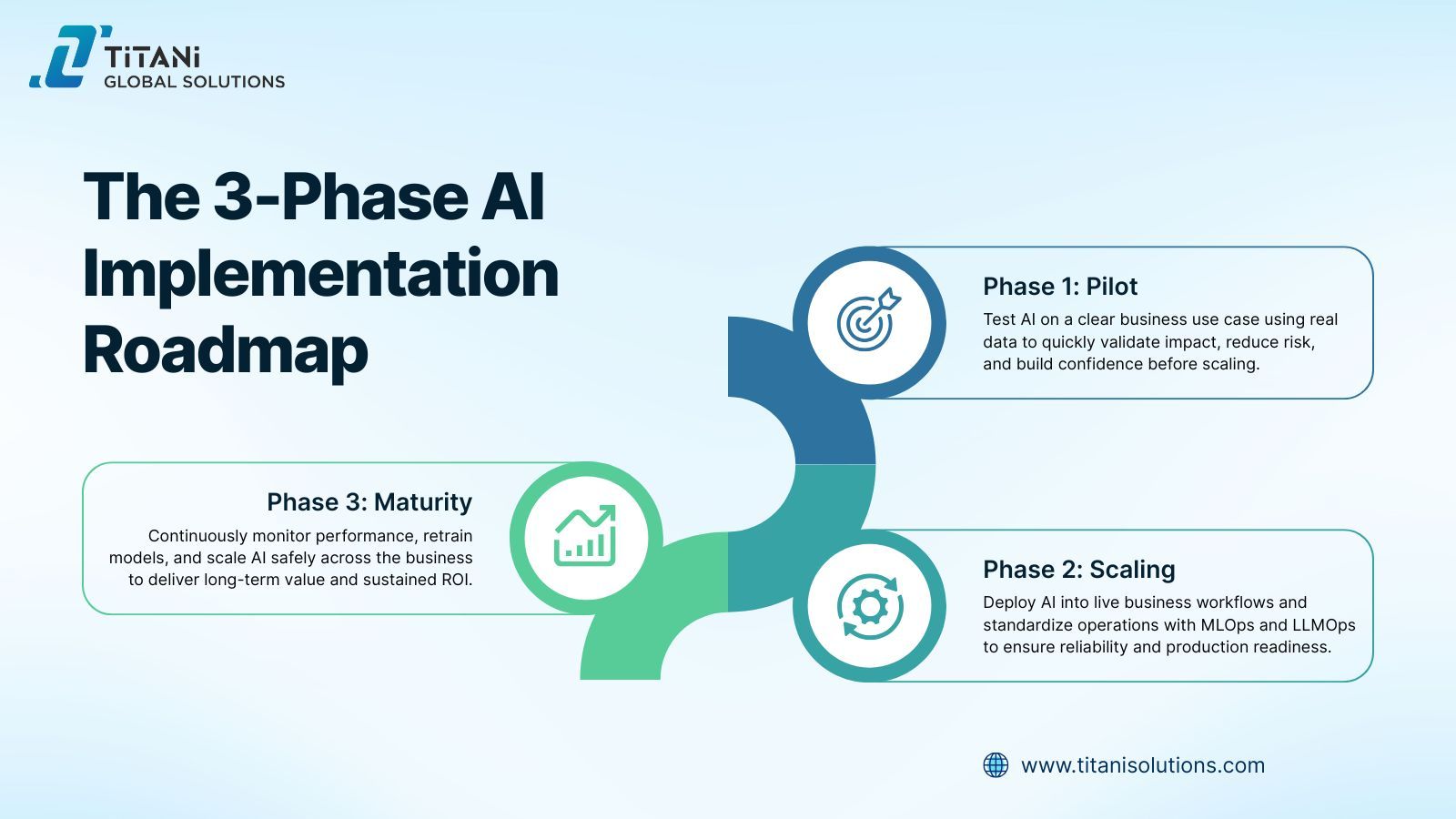
Phase 1: The Pilot — Proving Value in a Controlled Environment
The goal of the pilot phase is not to build the most sophisticated model, but to validate that AI can solve a specific, measurable business problem under controlled conditions. This phase acts as a de-risking mechanism, allowing the organization to understand how AI behaves with real operational data and how stakeholders adapt to new, automated workflows.
Rather than overcommitting resources, teams should target high-feasibility use cases with accessible, high-quality data. Success is defined by objective indicators: improved accuracy against the baseline, reduced manual workload, or demonstrable ROI within a short window. The true outcome of a successful pilot is not only a functioning model—it is organizational confidence that AI can deliver tangible value without disrupting the business.
Phase 2: Scaling — Moving from Experimentation to Operations
Once a pilot proves its worth, the question shifts from “Does it work?” to “Can it scale across the businesses?” This is where most AI initiatives struggle. As AI is introduced into production, it must interact with live data, real users, and mission-critical systems such as CRM and ERP. Without a standardized foundation, scaling becomes fragmented, costly, and difficult to maintain over time.
To close this gap, organizations must establish strong MLOps and LLMOps practices. This means automating the operational “plumbing” of AI: data ingestion, model training, deployment, observability, and versioning. Standardized pipelines transform AI from a fragile proof of concept into a dependable operational component. Phase 2 is ultimately about building the industrial-grade infrastructure required for sustainable AI adoption across multiple teams and business units.
Phase 3: Maturity — Continuous Optimization at Businesses Scale
In the final stage, AI evolves from a collection of individual projects into a mission-critical businesses capability. The focus shifts toward long-term stability, predictability, and performance. As AI usage expands, the priority becomes ensuring that models remain reliable, cost-efficient, and aligned with shifting business needs.
Organization -wide maturity requires a continuous optimization mindset. Organizations must monitor for model drift, manage compute resources responsibly, and enable automated retraining based on real-world performance signals. With governance, infrastructure, and lifecycle processes fully in place, new use cases can be deployed faster and more safely. At this point, AI is no longer a novelty—it becomes a compounding engine of growth that increases efficiency while minimizing operational debt.
Building a Future-Proof AI Operating Model
Most AI initiatives fail not because of weak models, but because the organization lacks an operating model to support them. Without a unified data platform, consistent pipelines, automated monitoring, and cross-functional collaboration, every new AI use case becomes a one-off project that is expensive to build and impossible to maintain.
A unified Data Platform is not just a convenience; it is the minimum requirement for AI reliability. Without consistent and governed data flows, models drift faster, errors multiply quietly, and every new use case requires rebuilding pipelines from scratch.
Structured lifecycle workflows—supported by MLOps and LLMOps—are what prevent AI from becoming unmaintainable. Most organizations underestimate how quickly models degrade once deployed. Automated validation, versioning, and retraining pipelines are the only way to keep AI dependable at scale.
Governance must be built in early. When it arrives late, teams are forced to rebuild data pipelines, redesign model behavior, or halt deployments entirely. Early governance is not bureaucracy—it is insurance for long-term AI stability.
Cross-functional collaboration is the hardest part of AI scaling. Most failures happen in Phase 2, not because the model breaks, but because data, engineering, compliance, and business teams operate in silos.
Titani’s approach reinforces all these components, helping organizations build AI systems that remain safe, transparent, and dependable as they grow.
Conclusion — A Practical Path to Responsible, Scalable AI Adoption
AI success is not defined by how advanced a model is, but by how effectively it operates inside real business workflows. Without the right structure, even promising AI initiatives remain fragile, costly, and difficult to scale.
Businesses that treat AI as a long-term operating capability rather than a one-off project gain a clear advantage. By grounding AI initiatives in real business priorities, validating value early, and scaling only when the foundation is ready, organizations reduce risk while accelerating time-to-impact.
A practical AI implementation roadmap brings discipline to this process. It replaces trial and error with clear sequencing, turns pilots into production-ready systems, and helps AI evolve into a dependable engine for efficiency, resilience, and growth.
If you are evaluating how to move AI forward in your business, Titani Global Solutions can help. Our team works with you to assess readiness, identify high-impact use cases, and design an AI implementation roadmap that scales safely into real-world operations.
Contact us to discuss your AI roadmap and next steps.