
Legacy software modernization is often approved with a deceptively simple budget: assess the application, rebuild or migrate it, test it, and launch. The real financial commitment is broader. It includes the cost of understanding undocumented dependencies, cleaning historical data, operating old and new systems in parallel, meeting regional data requirements, retraining users, and stabilizing the new environment after go-live.
For enterprises in the UAE, Saudi Arabia, and the wider GCC, these costs sit alongside strict continuity expectations, complex integration landscapes, and rapidly changing digital priorities. A credible business case must therefore compare the full cost of change with the full cost of staying as-is. This guide provides a practical framework for calculating both sides of that decision without relying on a generic price range.
Summary for Decision-Makers
The true cost of legacy software modernization is not the development quotation alone. It is:
True modernization cost = discovery and design + implementation + migration and transition + business change + risk reserve + future operating cost
The investment should then be compared with the cost of continuing to run the legacy system:
Legacy cost = visible operating cost + hidden operational effort + expected risk exposure + cost of delayed business initiatives
A sound financial model should:
Establish a 12-month current-state baseline before estimating savings.
Compare at least two options over a three-to-five-year period.
Include data remediation, parallel operations, compliance, training, decommissioning, and contingency.
Separate committed savings from potential value and show the funding peak, break-even point, and payback period.
Recalculate the case after discovery and the pilot, when uncertainty is lower.
This financial view complements Titani's broader guide to legacy system modernization services, which explains modernization strategies, technical-debt signals, and phased delivery.
Why Modernization Budgets Are Commonly Underestimated
Early estimates are usually built around visible engineering work. Legacy systems, however, contain hidden business rules, undocumented interfaces, inconsistent historical data, manual reconciliation, and exception scenarios known only to experienced employees.
This creates three gaps. Scope is inferred from what the application appears to do rather than what the business depends on. Transition is treated as deployment rather than a separate workstream. Finally, the model counts project spending but ignores current support effort, workarounds, incidents, and delayed initiatives.
The solution is not to add an arbitrary percentage to a weak estimate. It is to make the cost model more complete and reduce uncertainty in stages.
Step 1: Calculate the Current Cost of the Legacy System
Modernization savings cannot be credible without a baseline. Use the most recent 12 months where possible, then normalize unusual events such as a one-time hardware purchase or a major incident.
Direct technology operating costs
Begin with infrastructure, hosting, storage, backup, licences, internal support, specialist contractors, security remediation, audits, release management, regression testing, and production support.
Do not use the full cost of a shared platform if the application consumes only part of it. Allocate costs using a reasonable driver such as server usage, storage, support tickets, transactions, or team capacity.
Internal labour that the budget does not show
Some of the largest costs sit outside IT. Finance may reconcile records, customer service may re-enter data, operations may maintain spreadsheets, and engineers may spend release weekends on manual deployment.
Convert this effort into an annual cost:
Annual workaround cost = hours per month × loaded hourly cost × 12
Use loaded employment cost and validate the hours with process owners. Do not assume that every reported inefficiency will disappear.
Incident and downtime cost
Calculate both the cost of response and the business impact:
Annual incident cost = response labour + recovery expense + lost contribution + penalties or service credits
Revenue is not automatically equal to loss. Use contribution margin, unrecoverable transactions, contractual exposure, and measurable recovery costs. Keep rare major events in a separate risk model.
Cost of delayed change
A legacy system may be stable but still expensive because it slows other initiatives. Examples include a digital channel waiting for an API, an analytics program waiting for consistent data, or a market launch delayed by inflexible product rules.
For each constrained initiative, record the dependency, expected delay, value at risk, confidence level, and whether value is lost or merely deferred. This recognizes the economic effect of slow change without relying on vague claims about “innovation.”
Step 2: Build the Full Modernization Cost Stack
The modernization budget should be organized into distinct workstreams. This makes assumptions visible and prevents essential transition work from being hidden inside a single development line.
1. Assessment and discovery
Discovery includes application inventory, code and architecture review, dependency mapping, utilization analysis, data profiling, security assessment, stakeholder interviews, and option analysis. It determines what should be retained, moved, changed, replaced, or retired. AWS Prescriptive Guidance, for example, recommends granular analysis of current infrastructure, projected cloud costs, rightsizing, and optimization scenarios.
2. Target architecture and engineering
Include solution design, application changes, APIs, platform configuration, database work, delivery automation, observability, and documentation. Estimate by capability or migration wave, since backend rules and interfaces may require more effort than the visible screens.
3. Data remediation and migration
Data migration should have its own budget and owner. Include profiling, ownership decisions, cleansing, mapping, transformation, migration tooling, rehearsals, reconciliation, archiving, retention, cutover, and rollback preparation.
Not every historical record belongs in the new operational system. Moving unnecessary data increases cost, extends testing, and may create avoidable compliance exposure.
4. Integration discovery and redevelopment
Legacy interfaces are often underestimated because documentation is incomplete. Budget for interface tracing, API or event development, vendor coordination, environments, certificates, network rules, error handling, monitoring, and end-to-end testing. Check integrations used only at month-end, year-end, seasonal peaks, or regulatory reporting.
5. Quality assurance, security, and compliance validation
Testing may require automated regression, performance, resilience, disaster recovery, penetration testing, access review, data reconciliation, multilingual journeys, and continuity exercises. If the legacy platform has little automated coverage, creating that foundation is part of the investment.
6. Parallel operations and cutover
Critical systems may need old and new environments to operate together while data is synchronized and users transition. Model the duration and temporary duplication in licences, infrastructure, support, reporting, and operations.
7. Change management and training
Budget for process redesign, communications, training, user support, updated procedures, and adoption measurement. A technically successful system can underperform if users recreate old workarounds.
8. Decommissioning and post-launch stabilization
Include archiving, access removal, contract termination, infrastructure disposal, audit evidence, knowledge transfer, and stabilization. Start savings only when the related legacy cost can actually be removed.
9. Contingency and management reserve
Connect contingency to a risk register covering probability, impact, mitigation, owner, and budget treatment. Risks may include unknown code quality, unavailable test environments, third-party changes, data-cleaning volume, specialist availability, and extended parallel operations.
Step 3: Account for Middle East Cost Factors
The engineering problem may look similar across markets, but the delivery economics are not identical.
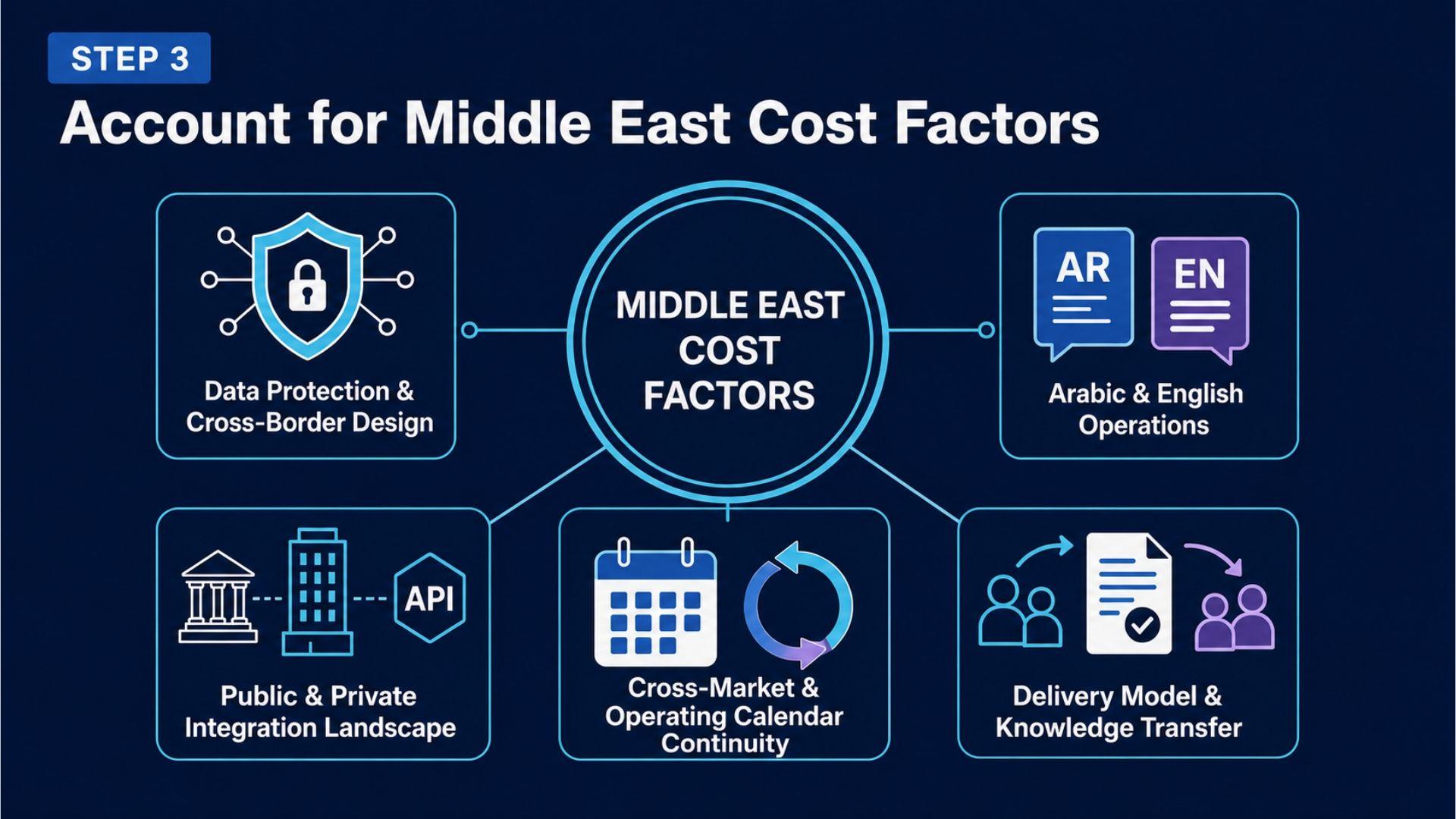
Data protection and cross-border design
The UAE’s official government portal describes Federal Decree-Law No. 45 of 2021 on the Protection of Personal Data as an integrated framework for protecting personal data. Saudi Arabia’s Personal Data Protection Law also establishes obligations for controllers and the processing and transfer of personal data.
Requirements depend on the entity, sector, data, jurisdiction, and architecture. Budget may therefore be needed for legal and compliance review, data classification, retention changes, hosting analysis, encryption, access logging, and migration evidence.
Arabic and English operations
Arabic and English delivery can affect right-to-left layouts, content, search, reports, documents, notifications, and testing. Where both languages are required, budget for real workflows, representative data, and user acceptance, not translation alone.
Complex public and private integration landscapes
Middle East enterprises may connect with government platforms, identity services, payment providers, banks, logistics partners, telecom operators, or sector-specific exchanges. Every external dependency adds coordination time, certification or approval steps, test-data constraints, and schedule risk.
Continuity across markets and operating calendars
Regional groups may need phased cutovers by country, entity, branch, or business unit. Financial close, peak seasons, public-sector deadlines, and religious holidays can restrict deployment windows and extend parallel-operation costs.
Delivery model and knowledge transfer
For onsite, nearshore, offshore, or blended delivery, consider travel, access, time-zone overlap, Arabic-speaking analysis, domain knowledge, handover, and internal decision capacity. A lower rate can produce a higher total cost if discovery or approvals are weak.
Step 4: Compare Modernization Options on the Same Basis
Do not compare a rehost estimate that includes only migration labour with a rebuild estimate that includes five years of operations. Give every option the same time horizon and cost categories.
Option | Initial cost tendency | Potential operating improvement | Residual legacy constraint |
Retain with controls | Low | Low | High |
Rehost | Low to moderate | Infrastructure-focused | Most application debt remains |
Replatform | Moderate | Platform, database, deployment, or scalability gains | Some architectural debt remains |
Refactor | Moderate to high | Better maintainability and change speed | Depends on refactoring scope |
Rebuild | High | Architecture and workflow can be redesigned | Migration and adoption risk |
Replace with package or SaaS | Moderate to high | Standardized operations and vendor-managed platform | Process fit, customization, and vendor dependency |
These are directional tendencies, not price bands. A highly regulated rehost with many dependencies can cost more than a contained rebuild. The purpose of the table is to expose trade-offs before the organization commits to a single approach.
Step 5: Create a Three-to-Five-Year Financial Model
Use annual or quarterly cash flows, depending on the program’s size. The model should include three views.
Current-state TCO
Legacy TCO = operating cost + business workaround cost + expected incident and risk cost + planned mandatory upgrades
Modernized-state TCO
Modernized TCO = modernization program cost + transition cost + future operating cost + retained legacy cost
“Retained legacy cost” matters when only part of the estate is modernized or when a legacy component must continue supporting historical data or downstream systems.
Incremental value
Net value = avoided legacy cost + productivity value + risk reduction + enabled business value − modernized-state TCO
Keep the categories separate:
Committed savings have an approved removal action, such as terminating a support contract.
Operational benefits depend on adoption, such as fewer manual processing hours.
Risk reduction is probability-weighted and should not be presented as guaranteed cash.
Enabled value depends on another business initiative and should have its own owner.
Then calculate:
ROI = (total quantified benefits − total investment) ÷ total investment × 100
Payback period = time required for cumulative net benefits to recover the investment
For longer programs, finance teams may also use net present value and an agreed discount rate. The key is consistency across options, not the appearance of mathematical precision.
Illustrative Modernization Cost Example
Consider a GCC distribution company modernizing a core order and inventory application. The figures below are illustrative planning assumptions, not a Titani customer case or a market price benchmark.
The current system costs USD 720,000 per year to operate, including infrastructure, licences, support, manual reconciliation, testing, and average incident-response costs.
The initial engineering estimate is USD 1.15 million. A full cost review adds:
USD 140,000 for data remediation and migration rehearsals
USD 180,000 for parallel operations and phased cutover
USD 90,000 for training, process change, and user support
USD 70,000 for decommissioning and post-launch stabilization
USD 195,000 in contingency linked to identified risks
The total modernization investment is therefore USD 1.825 million, not USD 1.15 million.
After stabilization, the new annual operating cost is expected to be USD 430,000. The model also identifies USD 220,000 in annual operational benefits from reduced manual processing and faster testing. It treats potential revenue from future digital services separately because those services have not yet been approved.
On that basis, recurring quantified benefit is:
USD 720,000 − USD 430,000 + USD 220,000 = USD 510,000 per year
Simple payback is approximately 3.6 years after benefits begin. The real cash-flow model would also reflect the implementation period, benefit ramp-up, contract termination dates, and discounting.
This example shows why a project can be more expensive than its first estimate yet still be financially sound. It also shows why optimistic claims about revenue should not be required to justify an operationally valuable program.
Calculate the Cost of Doing Nothing
“Do nothing” is not a zero-cost option. It is a decision to continue funding the current operating model and accept its risk trajectory.
Model annual support, infrastructure, licences, specialist capacity, mandatory upgrades, volume growth, manual work, incidents, delayed initiatives, and the future cost of modernizing a more complex estate.
Avoid assuming that every cost rises at the same percentage. Use contracts, capacity forecasts, support history, and specific risks. Compare this baseline with a “modernize now” scenario and, if useful, a “defer for 12 or 24 months” scenario.
Deferral may be rational when dependencies are unresolved or business priorities are changing. However, the decision should show the price of waiting, the risks accepted, and the conditions that will trigger reassessment.
How to Keep the Modernization Budget Under Control
Fund discovery and validate through a pilot
Use a bounded assessment to map dependencies, profile data, measure utilization, and compare options. Then use a pilot to test architecture, migration, testing, deployment, observability, adoption, and support. Update the estimate with actual delivery data before scaling.
Prioritize capabilities and assign benefit owners
Modernize high-value workflows or bounded domains first instead of reproducing every legacy function. Assign each benefit to an owner, date, measurement source, and removal action. Without an owner commitment, classify the benefit as potential.
Use stage gates and forward-looking reporting
Release funding through assessment, pilot, migration waves, and decommissioning. At each gate review actual spending, committed cost, estimate to complete, remaining contingency, forecast benefits, realized benefits, and unresolved risks. This allows scope or sequencing to change before an overrun becomes unavoidable.
Conclusion: Turn the Estimate into an Investment Case
The true cost of legacy software modernization in the Middle East is shaped by more than engineering effort. Data remediation, integration complexity, bilingual operations, regional compliance, parallel running, business adoption, decommissioning, and risk all affect the investment.
The strongest business case begins with a verified current-state baseline, compares options over the same period, separates committed savings from uncertain value, and updates the forecast as evidence improves. This does not eliminate uncertainty. It makes uncertainty visible, owned, and financially manageable.
Titani can support application assessment, cost and option analysis, custom software engineering, data migration, testing, cloud readiness, and post-launch support. Explore our cloud services or contact Titani to discuss a practical modernization assessment for your application portfolio.
Frequently Asked Questions
How much does legacy software modernization cost?
There is no reliable universal price. A credible estimate should follow discovery and include engineering, migration, transition, business change, contingency, and future operations.
What costs are most often missed in a modernization budget?
Frequently missed costs include dependency discovery, data cleansing, interface redevelopment, test automation, security validation, parallel operations, training, contract overlap, decommissioning, stabilization, and internal expert time.
Should modernization ROI include risk reduction?
Yes, but risk reduction should be shown separately from cash savings. Use an agreed probability and financial impact, document the assumptions, and avoid presenting the full value of a possible incident as guaranteed benefit.
How long should a modernization TCO model cover?
Three to five years is often useful for comparing implementation cost, transition spending, future operations, and benefit realization. The appropriate period depends on program duration, asset life, contract terms, and the organization’s investment policy.