
Enterprise AI can expose sensitive information far beyond the initial prompt. Data may appear in retrieved documents, embeddings, model context, connected applications, operational traces and human-review queues. Hosting a model on-premises can reduce some exposure, but infrastructure location alone does not determine who can access data, what an AI agent may do or whether an investigation can reconstruct a decision.
For enterprises in Saudi Arabia and the United Arab Emirates, the practical requirement is a controlled platform that protects data before, during and after AI processing. This guide explains how a privacy-preserving AI platform works, where exposure occurs, how regional requirements affect design, which architectural layers are needed and how to move from a bounded use case to production.
What Is an Enterprise Privacy-Preserving AI Platform?
The term privacy-preserving AI platform describes an enterprise environment that combines AI models, business data, identity, permissions, privacy controls, runtime safeguards, monitoring and audit evidence. Some product and search language shortens this to privacy AI platform, but the longer form is clearer: privacy is an architectural property of the platform, not a separate type of AI.
The platform may support a knowledge assistant, predictive model, document-processing workflow or AI agent. Its defining feature is not a particular model or hosting arrangement. It is the ability to control how data enters the system, how it is retrieved and processed, what the model or agent can access, and what evidence remains afterward.
Related terms overlap, but they are not interchangeable:
Concept | Primary focus |
Private AI | An AI environment operated within infrastructure controlled by the organization or an approved provider |
Privacy-preserving AI | Methods and controls that limit unnecessary disclosure, reuse or inference of sensitive information |
AI security | Protection against unauthorized access, manipulation, prompt injection and other attacks |
Privacy-preserving AI platform | An integrated architecture combining infrastructure, data governance, access, runtime controls and auditability |
A private deployment can still expose data through excessive permissions, poorly secured retrieval, unrestricted agent tools or verbose logs. Privacy therefore has to be designed across the full AI workflow.
Where Sensitive Data Can Be Exposed in Enterprise AI
Enterprise AI adds new locations where sensitive information can appear or move.
Prompts and Uploaded Files
Employees may place customer records, contracts, source code or financial information into prompts. Input inspection, classification and clear usage policies are needed before content reaches a model.
RAG, Embeddings and Vector Databases
Retrieval-augmented generation can return a document that the current user was never authorized to view. An over-broad index can also collapse separation between departments, projects or tenants.
Model Context, Memory and Training Data
Conversation history, memory, fine-tuning datasets and evaluation records can preserve information beyond the original interaction. Systems must define how each is retained, corrected and deleted.
AI Agents and Connected Actions
An agent may query a CRM, update an ERP record or call an external API. With broad credentials, an incorrect or manipulated instruction can become a business action.
Logs, Monitoring and Human Review
Prompts, retrieved passages, outputs and traces support investigations, but they can also create secondary copies of sensitive data. Observability must follow minimization, access and retention rules.
What KSA and UAE Enterprises Must Design For
Privacy architecture should begin with the law, regulatory perimeter and industry rules that apply to the use case. The following points are design considerations, not legal advice.
KSA Data Protection Considerations
The Saudi Personal Data Protection Law and its Implementing Regulations address lawful purpose, minimization, access, retention, destruction, security and processing records. An AI platform should map which personal data enters prompts or knowledge stores, identify controller and processor roles, and document the processing lifecycle.
SDAIA's Regulation on Personal Data Transfer Outside the Kingdom does not require all personal data to remain inside Saudi Arabia. It sets transfer conditions and mechanisms such as adequacy, Standard Contractual Clauses and Binding Common Rules. Risk assessment is required in specified cases, including certain safeguarded transfers and continuous or large-scale transfers of sensitive data. SDAIA's February 2025 Risk Assessment Guideline for Transferring Personal Data Outside the Kingdom supports this process.
The architecture must show where storage, inference, support access, backups and logs are located. A regional endpoint is insufficient if data can be accessed or replicated elsewhere.
UAE Data Protection Considerations
The UAE Federal Decree-Law No. 45 of 2021 on the Protection of Personal Data addresses lawful processing, security, data-subject rights, automated processing, impact assessment and cross-border transfers. Use cases involving new technology, profiling, sensitive data or high privacy risk may require stronger assessment and documentation.
Organizations may also fall within DIFC, ADGM or sector-specific rules. The team should confirm the applicable jurisdiction before selecting a deployment region or model provider.
Translate Legal Requirements into Technical Controls
Legal and compliance teams should be able to answer five architectural questions:
Define which data categories may enter each AI use case.
Assign who may request, approve, access and administer that data.
Document where data is stored, processed, transferred and backed up.
Enforce retention, correction, deletion and incident procedures.
Produce evidence showing what happened during a specific AI interaction.
No platform should be called “fully compliant” based on hosting or a generic certification alone. Compliance depends on the use case and implemented controls.
Seven Layers of a Privacy-Preserving AI Platform
A robust privacy-preserving AI platform uses layered controls. Each layer reduces a different failure mode, and no single control compensates for the absence of the others.
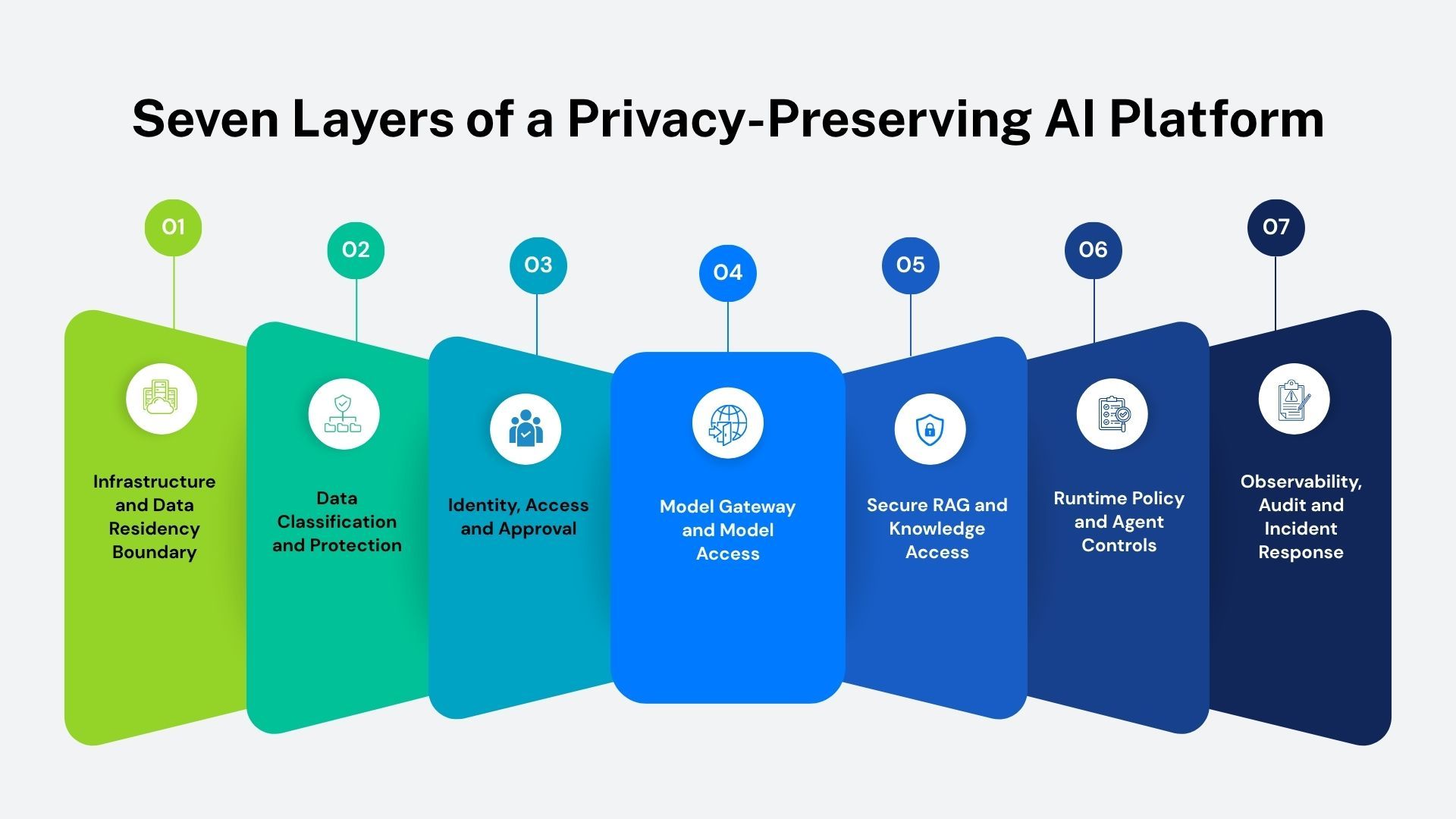
1. Infrastructure and Data Residency Boundary
Without an explicit boundary, residency and access assumptions cannot be tested.
The first layer defines the physical and logical boundary. Options include managed enterprise AI, a virtual private cloud, on-premises infrastructure or a hybrid design. Teams must trace model inference, storage, vector databases, backups, observability, encryption keys and support access.
Minimum controls include segmentation, private endpoints, encryption, restricted administration, key-management policies and documented data locations. A common mistake is to choose a regional cloud service while leaving logs or vendor support outside the boundary.
2. Data Classification and Protection
Misclassified data will receive either insufficient protection or unnecessary friction.
Enterprises should classify data as public, internal, confidential or restricted, then map each category to permitted models, destinations and use cases.
Before content reaches a model, the platform may need to remove fields, redact identifiers, tokenize values or use synthetic test data. Retention and deletion must cover prompts, files, embeddings, caches, outputs and traces. Technologies such as confidential computing or differential privacy should solve a defined risk, not become architecture by checklist.
3. Identity, Access and Approval
A valid login does not justify every retrieval or action.
Enterprise AI inherits permissions from many systems, but a permission that is acceptable in a source application may be too broad for retrieval or agent actions. Identity controls must determine not only who can enter the platform, but also which data, models, tools and actions each user or service account can invoke.
The minimum design includes SSO, MFA, role- or attribute-based access, least privilege, service-account governance and separation of duties. High-risk requests may need a data-owner, security or DPO approval that records purpose, scope, conditions, expiry and decision.
4. Model Gateway and Model Access
Without a shared gateway, each integration can implement a different control standard.
Direct connections from business applications to multiple model providers create inconsistent controls and limited visibility. A model gateway provides a governed entry point for routing, authentication, policy checks and vendor management.
The gateway can restrict models by data class, inspect inputs and outputs, manage credentials and record the model configuration used. Rules need versioning, testing and exception management. Highly sensitive inputs may need to be blocked rather than merely logged.
5. Secure RAG and Knowledge Access
A secure model can still expose information through an insecure retrieval layer.
RAG quality depends on retrieving useful context, but privacy depends on retrieving only authorized context. Source permissions should be preserved through ingestion, indexing and retrieval. Document-level, row-level or field-level access may be required, depending on the source.
Indexes may need separation by tenant, business unit or sensitivity. Source access changes should propagate to retrieval, while deleted content must leave indexes and caches. Teams should also test indirect prompt injection. The OWASP Top 10 for LLM and GenAI applications identifies prompt injection and sensitive information disclosure as distinct risks.
6. Runtime Policy and Agent Controls
This layer prevents an authorized request from becoming an unauthorized action.
Runtime controls determine what the system may do after initial access checks. Policies should restrict tools, target systems, data scope, transaction values and action frequency. High-impact actions should require deterministic validation or human approval.
Credentials should be scoped to the task. Memory needs clear boundaries, and outputs must be validated before becoming updates, messages or transactions. The platform also needs a safe failure state when the model is uncertain or a policy cannot be evaluated.
7. Observability, Audit and Incident Response
Without trustworthy evidence, teams cannot prove, investigate or improve control performance.
The final layer makes every control reviewable. A useful trace links identity, input, retrieved sources, model version, policies, output, tool calls, approvals and actions, enabling investigation of a material interaction.
Auditability does not mean storing every prompt forever. Logs should be minimized, protected and retained by purpose. Alerts should detect unusual access, policy violations and cross-tenant retrieval. The platform should support evidence export, deletion and incident containment. The NIST AI Risk Management Framework reinforces managing AI risk throughout the lifecycle.
How Privacy Controls Work in Practice: PAMOLA and AYITA
The seven layers become easier to understand when controls are viewed across the lifecycle of one AI request.
Before processing, an organization may need to decide whether a proposed use of sensitive data is justified and who has authority to approve it. Titani's PAMOLA case study illustrates a control pattern for AI approval on sensitive data, combining privacy evaluation, risk assessment and audit-ready evidence. The important architectural principle is that approval becomes a recorded gate before data enters an AI workflow.
During execution, authorization alone is insufficient. The platform must keep the model or agent inside defined data, memory, inference and action boundaries. Titani's AYITA case study illustrates the complementary need for control, traceability and auditability in production AI.
After execution, approval records, policy decisions and operational traces should create reviewable evidence. PAMOLA and AYITA should be understood here as complementary control patterns, not represented as a single integrated platform unless a specific implementation confirms that integration.
Choosing the Right Deployment Model
Deployment should follow the workload's risk, integration and operating requirements rather than a general preference for cloud or on-premises systems.
Model | Best fit | Main trade-off |
Managed enterprise AI | Lower- to medium-risk use cases that need rapid deployment and mature managed services | Less direct control over infrastructure and provider operations |
VPC or private cloud | Workloads requiring network isolation, private connectivity and organization-specific configuration | Higher integration and platform-management effort |
On-premises | Highly sensitive workloads or strict infrastructure constraints | Greater cost, skills requirements and model-operations burden |
Hybrid architecture | Portfolios with different data classes, latency needs and model requirements | More complex routing, governance and monitoring |
The build, buy or hybrid decision should compare data sensitivity, regulatory scope, model flexibility, legacy integration, audit evidence, time to production and total operating cost. Buying a managed service can accelerate a bounded use case. Building selected control layers may be justified when workflows or evidence requirements are distinctive. In many enterprises, hybrid is the practical answer: reuse managed models and infrastructure where appropriate, while retaining control of data preparation, identity, gateways, retrieval, policy and observability.
A Practical Roadmap for Building the Platform
Step 1. Select and Risk-Tier the Use Case
Choose one use case with measurable business value and a data scope that can be controlled. Define prohibited inputs, expected users, decision impact and an accountable business owner.
Step 2. Map Data and Processing Flows
Document each source, data category, owner, purpose, storage location, transfer path, recipient and retention period. Include embeddings, caches, backups and logs, not only the primary system.
Step 3. Define Privacy and Security Requirements
Complete the relevant impact assessment and threat model. Translate identified risks into testable requirements for identity, retrieval, model access, actions, monitoring and deletion.
Step 4. Build the Minimum Control Architecture
Implement the boundary, data filtering, identity, model gateway, retrieval permissions, approval points and traceability needed for the pilot. Avoid building an enterprise-wide platform before one control pattern has been validated.
Step 5. Test Realistic Privacy Scenarios
Test sensitive-data leakage, unauthorized retrieval, indirect prompt injection, excessive agent permissions, cross-tenant access, log exposure and failed deletion. Titani's AI software testing checklist provides a broader production-readiness structure for AI-powered systems.
Step 6. Pass Production Gates and Scale
Require sign-off for privacy, security, governance and operational readiness. Scale by adding approved use cases and shared controls, not by removing safeguards to improve adoption.
Privacy-Preserving AI Metrics and Production-Readiness Checklist
Metrics should show whether controls work without making the platform unusable.
Privacy and security: measure sensitive-data exposure in controlled tests, blocked unauthorized retrieval, policy violations, excessive permissions, unresolved high-risk findings and retention or deletion failures.
Governance and evidence: measure the percentage of high-risk requests receiving required approval, executions with complete traces, time to investigate an interaction and time to produce audit evidence.
Operations: measure approval turnaround, gateway latency, control false positives, incident detection time and the number of exceptions that remain open past their expiry.
Before production, confirm that the organization can identify the owner of the use case, restrict data and actions, reconstruct a material interaction, revoke access, delete required records and contain an incident. Universal benchmarks would be misleading because risk tolerance, workload and legal scope differ. Establish a baseline during the pilot and tighten thresholds as evidence improves.
Conclusion: Privacy Must Be Part of the AI Architecture
A privacy-preserving AI platform is not created by choosing on-premises hosting or publishing an acceptable-use policy. It requires coordinated controls over infrastructure, data, identity, models, retrieval, runtime actions and evidence. For KSA and UAE enterprises, those controls must also reflect the applicable jurisdiction, sector and cross-border processing model.
Titani designs production-ready AI solutions that combine secure access to private data with workflow controls, monitoring and traceability. Our delivery practices include structured information-security controls aligned with ISO 27001:2022 standards. Explore our enterprise AI capabilities or discuss a privacy-sensitive AI use case with our team.
Frequently Asked Questions
What is the difference between a private AI platform and a privacy-preserving AI platform?
A private AI platform emphasizes an environment controlled by the organization or an approved provider. A privacy-preserving AI platform adds controls over data purpose, minimization, permissions, retrieval, model use, runtime actions, retention and evidence. Private infrastructure can be one component, but it does not automatically provide privacy.
Do KSA and UAE enterprises have to keep all AI data inside the country?
Not as a universal rule. Cross-border processing depends on the applicable law, jurisdiction, sector, data and transfer mechanism. KSA regulations establish conditions and safeguards for transfers outside the Kingdom. UAE organizations must consider the federal PDPL and any relevant free-zone or sector rules. Each workload requires a specific assessment.
Does on-premises AI automatically guarantee data privacy?
No. On-premises hosting can increase infrastructure control, but excessive user permissions, insecure RAG, unrestricted agent tools, weak logging practices or poor retention can still expose data. Privacy depends on the complete architecture and its operation.
Can enterprises safely use public cloud AI models with sensitive data?
Potentially, if the service, contract, region, configuration and controls meet the use case's requirements. The organization must understand how inputs are retained or used, restrict data sent to the model, protect connections, enforce access, monitor processing and maintain required evidence. Highly sensitive workloads may require a private endpoint, VPC, dedicated deployment or a different model.